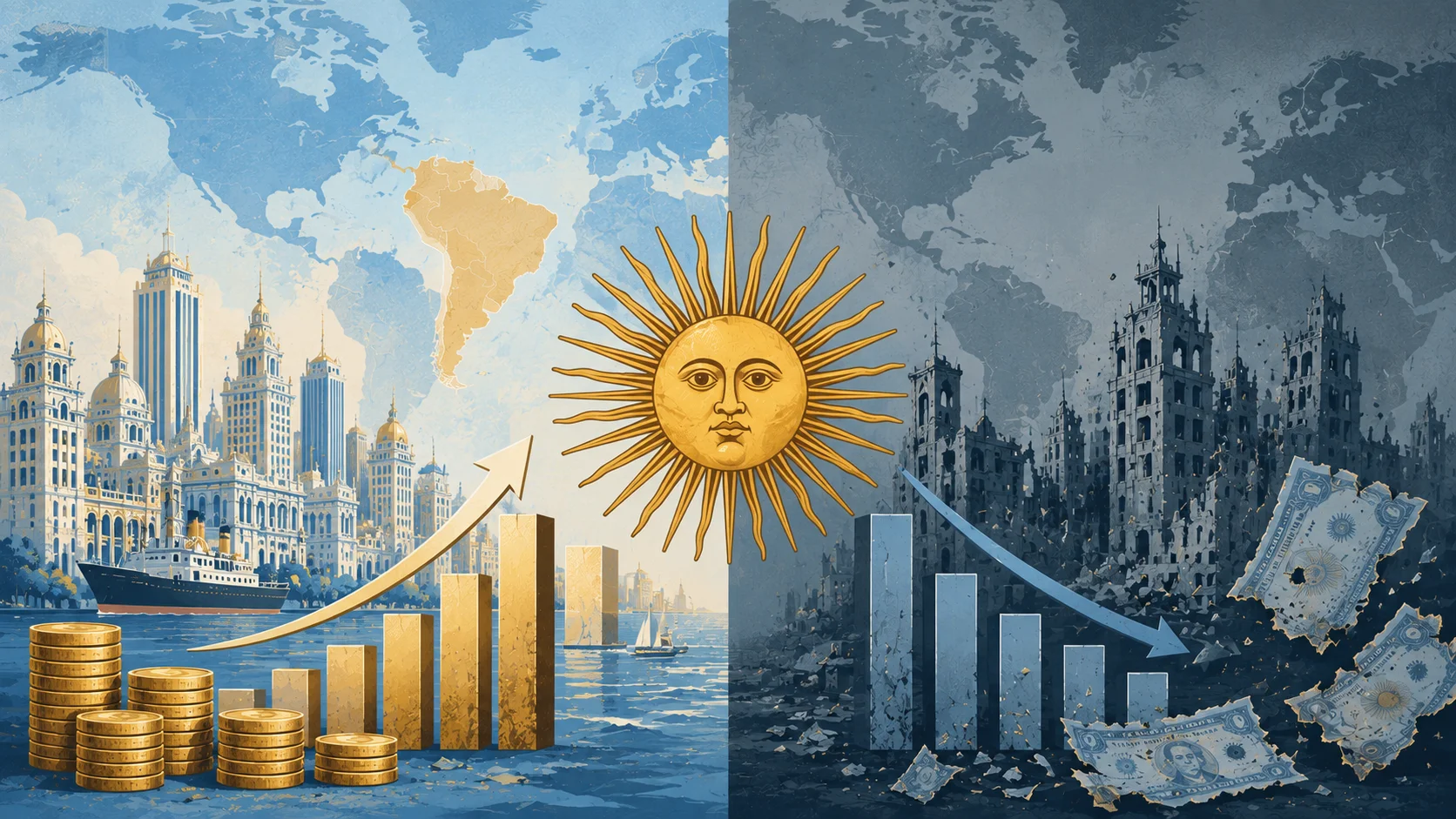
I was having a conversation about economics and someone mentioned that around 1910, Argentina's income per person was higher than France's or Germany's. Higher than Germany's. I had to sit with that for a moment. Argentina was not just doing well. It was competing with the richest industrial nations on Earth.
Then came the inevitable question: what happened? How do you go from that position, with grand architecture in Buenos Aires earning the city the nickname "The Paris of South America," to becoming the country that economists study when they want to explain how a wealthy nation can fall apart from the inside?
A country that developed backward
Most economic stories are about countries moving from poor to rich. Argentina ran the story in reverse. Economists even gave it a name: the Argentine Paradox. It is the only well-documented case of a country that reached full development status and then slipped back into the category of a volatile, unstable developing economy. Not because of a war. Not because of a natural disaster. Because of a series of political and policy choices that compounded over decades.
The early wealth was real. Argentina sat on the Pampas, one of the most fertile stretches of land on the planet. It exported beef and wheat, primarily to the United Kingdom, and European immigrants arrived by the millions looking for prosperity. For a few decades, the formula worked brilliantly.
When your entire economy depends on selling one type of thing to one group of buyers, you are one bad global event away from catastrophe. Argentina's agricultural exports looked like strength. They were actually a single point of failure.
How the decline actually happened
The Great Depression of 1929 was the first major shock. When global trade collapsed, the UK and other major economies turned inward with trade barriers. Argentina's export engine stalled almost immediately. A country that had built its entire infrastructure of wealth around selling beef and grain to Europe suddenly had nowhere to sell.
GDP per capita rivals France and Germany. Buenos Aires construction boom. European immigration at record levels.
Global trade collapses. UK raises trade barriers. Argentina's agricultural export revenues crater almost overnight.
Economic pain triggers political fracturing. Democratic government overthrown. Investor confidence in institutional stability collapses. This begins six military coups across the 20th century.
Juan Peron comes to power. The state heavily taxes agricultural exporters to fund domestic factories. Wages rise, public spending expands. Short-term popular support, long-term structural damage.
Successive governments borrow in foreign currencies and print money to cover deficits. Each crisis makes the next one worse. Hyperinflation episodes erode savings repeatedly.
The economy implodes. Bank accounts frozen. The peso loses most of its value. The country defaults on its debt and goes through five presidents in two weeks.
What made Peronism particularly damaging in hindsight was the logic behind it. Juan Peron genuinely wanted to build domestic industry so Argentina would stop depending on foreign imports. That is not an unreasonable goal. But to fund those factories, the state taxed the agricultural sector, which was the country's only real source of export revenue. The domestic factories that came out of this were heavily protected and never became efficient enough to compete globally. When export revenues fell, the government did what governments in that position tend to do: it printed money.
Once you start that cycle, it is extremely difficult to stop. The money printing creates inflation. The inflation destroys savings and purchasing power. People lose trust in the currency. Governments borrow from foreign creditors in US dollars to stabilize things. But when the peso loses value, the dollar-denominated debt becomes effectively larger. Default follows. Then another round of printing. Argentina went through this loop nine times.
The comparisonWhat India and China are doing differently
The Argentine story is a useful frame for looking at other large economies, because it shows very clearly what the failure modes are. I found the comparison to India particularly striking.
| Economic factor | Argentina's historical trap | India (2026) | China (2026) |
|---|---|---|---|
| Export base | Beef and wheat to a handful of buyers | Diversified across tech services, pharma, electronics | Concentrated in industrial goods; facing trade war pushback |
| Debt currency | Borrowed in foreign currency (USD); peso collapse multiplied debt | Mostly rupee-denominated; insulated from currency shocks | Mostly yuan-denominated; state controls the banks |
| Central bank independence | Central bank used as a political spending tool; chronic inflation | RBI operates independently with inflation targets and FX buffers | State-directed, but used for stability rather than vote-buying |
| Political stability | Six military coups in the 20th century; no institutional continuity | Decades of democratic continuity; stable regulatory frameworks | Centralised stability, though at the cost of political freedom |
| Domestic consumption | Artificially inflated by money printing, wiping out savings | Growing but still developing; youth employment is a challenge | Deeply depressed; factories producing far more than citizens can absorb |
| Fiscal discipline | Structural deficits funded by printing and external borrowing | Deficit target at 4.4% of GDP with infrastructure focus | Local government debt concentrated in deflating property sector |
The key thing India got right is the debt currency. Argentina's recurring collapses were amplified by one specific mechanism: when the peso lost value, the government's foreign-currency debt became proportionally larger in peso terms. That created a vicious circle where devaluation made the debt worse, which forced more printing, which caused more devaluation. India finances its debt primarily in rupees, which breaks this particular trap entirely.
China is a more complicated case. It does not have Argentina's political instability. Its debt is also largely internal and denominated in yuan. But China has built an economy that depends heavily on foreign buyers absorbing its industrial output, because domestic consumers do not spend enough to keep its factories running at capacity. That is a different version of the same export-dependency problem Argentina had with beef and wheat. The products are more sophisticated. The vulnerability is structurally similar.
The United States angleEven superpowers can drift
What struck me most in thinking through this was the US comparison. The United States has a fiscal deficit running at roughly 5.8% of GDP, with net interest payments on its debt approaching $867 billion a year. That is not a small number. And the political dynamics in Washington make it very difficult to either cut major spending programs or raise taxes to address it.
The reason Argentina's story does not apply cleanly to the US is the dollar's role in global trade. Because oil, commodities, and central bank reserves worldwide are priced in dollars, there is a structural global demand for US currency and US debt that no other country has. Argentina printed pesos and the peso collapsed. The US prints dollars and much of that inflation gets absorbed by global markets holding dollar reserves. This is what economists call "exorbitant privilege."
Argentina is a slow-motion lesson, not a sudden one
The Argentine decline took decades. Nobody in 1920 looked at Buenos Aires and said "this is going to collapse." The decline came from small compounding choices: taxing your only export earner to fund protected industries, borrowing in foreign currency because it was cheaper, using the central bank to fund popular spending programs. Each individual decision made short-term political sense. The long-term arithmetic was brutal. The lesson is not about dramatic failures. It is about how a country in a very strong position can slowly make itself weak through entirely avoidable policy choices.
I think about the Argentine story differently now than I did before. I used to think of it as a Latin American problem, something tied to that region's history. But the structural mechanisms are universal. Any economy that concentrates too much on a single export, borrows in foreign currency, and subordinates its central bank to short-term political needs is running the same risk. Some countries have the luxury of more margin for error than others. Argentina simply ran out of margin faster than most.
Common questions