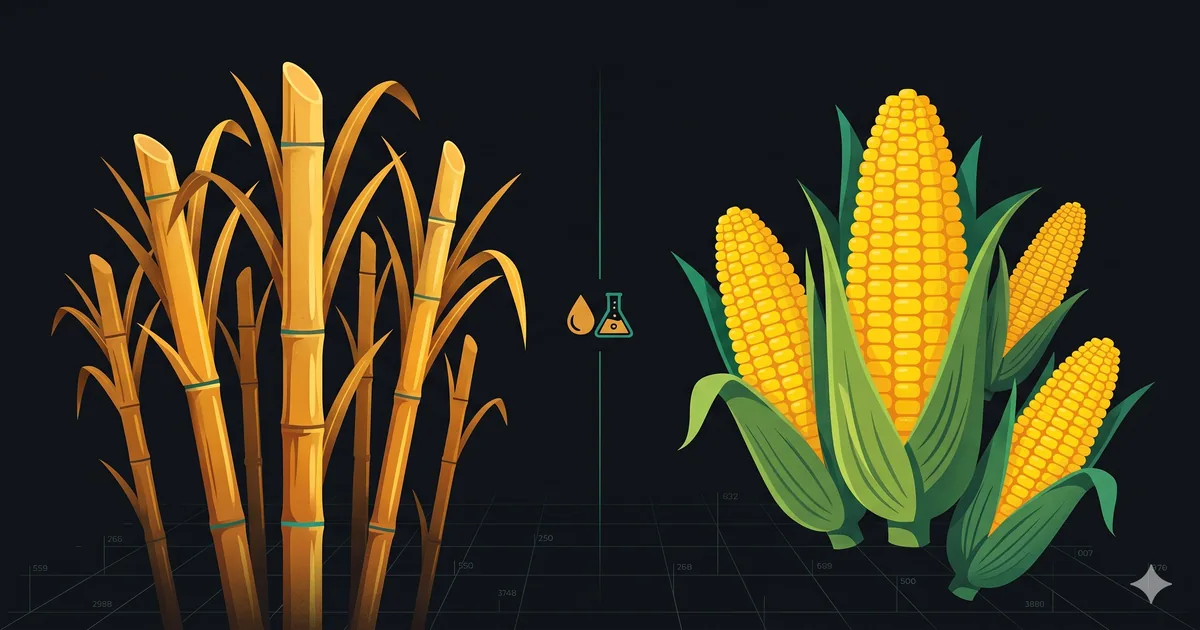
I started with a simple question. Ethanol comes from sugarcane or corn, so which one should I be looking at from an investing angle? About an hour later, I realised I had been asking the wrong question entirely.
In India, the ethanol story is not about choosing between two crops. It is about a structural shift in how the government wants to power the country's vehicles, and which companies are positioned to ride that shift without getting knocked over by it.
The basics firstTwo crops, two very different processes
Sugarcane ethanol is the simpler one. You squeeze the juice out, ferment the sugars, distill it. The sugars are already there and ready to go. Brazil built an entire national fuel economy on this model, and it works well.
Corn ethanol takes an extra step. The starch in corn kernels has to be broken down into fermentable sugars first, using enzymes, before fermentation can happen. It sounds like a small thing but it adds cost and complexity. The US runs on this model, and American corn ethanol has driven entire commodity markets for decades.
Why India is pivoting to corn
The short answer is water. Sugarcane is one of the most water-intensive crops on the planet. When you are trying to scale ethanol production to hit a 20% blending target across the entire country, you cannot do it entirely on sugarcane without running into serious agricultural and food security constraints.
So the government started incentivizing grain-based ethanol, especially corn, as a way to diversify feedstocks. The logic is that India's projected food grain surpluses by 2047-48 need somewhere to go, and converting them to fuel is one answer. Corn also has a year-round supply potential that sugarcane, with its four-to-five month crushing season, simply cannot match.
The result is that corn now accounts for roughly half of India's ethanol production. A few years ago that number was far smaller. This happened fast, and most retail investors watching sugar company stocks did not fully appreciate what it meant.
The government has capped sugar-based feedstocks at around 28% of the ethanol mix for the 2025-26 supply year. This is the number that is currently creating pressure on pure sugarcane-focused distilleries.
Is this bad for sugar companies? It depends entirely on what they did next.
This is the part where I think the framing in most financial news goes wrong. The headline tends to be "corn ethanol hurts sugar stocks." That is only true for companies that sat still.
The smarter sugar companies saw this coming and retrofitted their plants into what the industry now calls multi-feedstock distilleries. During the sugarcane crushing season they run on cane juice or molasses. During the off-season they switch to corn or other grains. Their distillery assets run year-round instead of sitting idle for seven months. Returns on capital go up. Revenue becomes more predictable.
For companies that made this shift, corn is not competition. It is a buffer. It fills the gap when cane supply is tight, when monsoons fail, or when the government restricts sugar diversion to protect domestic food prices.
Who is actually in this spaceThree names worth understanding
One of the largest integrated players. They have invested heavily in multi-feedstock capacity, allowing them to switch between sugar-based and grain-based production to maximize plant utilization throughout the year.
A major bio-energy player with 1,250 KLPD of distillery capacity. Their strategy explicitly includes dual-feed infrastructure. The challenge is margins, not capability. They can process corn. The question is how efficiently.
Among the players aggressively expanding grain-based distillery capacity. Worth watching for how their utilization rates evolve as the feedstock mix shifts through the year.
Sugarcane vs corn: a practical breakdown
| Factor | Sugarcane | Corn |
|---|---|---|
| Conversion process | Direct fermentation of sugars | Enzymatic starch conversion, then fermentation |
| Seasonality | 4-5 months only | Year-round supply |
| Water intensity | Very high | Significantly lower |
| By-products | Molasses, bagasse (for power) | DDGS (high-protein animal feed) |
| Govt policy priority | Capped at 28% of ethanol mix | Actively incentivized |
| Energy balance | Generally higher | Varies by farming practice |
| Price volatility | Tied to sugar cycle | Tied to grain prices, more stable |
The question is not sugarcane or corn. It is adaptation.
I find this whole sector genuinely interesting because the investment story here is not really about ethanol at all. It is about which management teams understood that their business model needed to change, and actually did something about it.
A sugar mill that remained a sugar mill is now a weaker business. The government has capped how much of its output can go into the ethanol program. Sugar export bans have periodically hurt their margins. The fair and remunerative price they must pay farmers keeps rising, but the minimum selling price for sugar has not kept pace. Those companies are in a squeeze.
A sugar mill that became an integrated bio-refinery is a different story. It has ethanol revenue that does not depend on the sugar price. It has DDGS sales from its corn processing lines. It has power revenues from bagasse co-generation. It runs plants year-round. The stock market will eventually price this transition in, though it sometimes takes longer than it should.
For Shree Renuka specifically, the capability to process corn is not in question. They have the infrastructure. The stock is currently under pressure because of industry-wide margin compression and policy uncertainty. That might be a window, or it might be a warning. I genuinely do not know which, and I would not pretend to.
Look for feedstock flexibility, not crop loyalty
The companies worth watching are not the sugarcane companies or the corn companies. They are the ones that built the capacity to use both, run their plants twelve months a year, and generate revenue streams that the sugar cycle cannot knock over. That is the actual investment thesis here.
Nothing here is investment advice. I am not a SEBI-registered advisor and I have no idea what the market will do next week, let alone next year. This is just me thinking through a sector I found interesting. Do your own research, or talk to someone who is actually qualified.