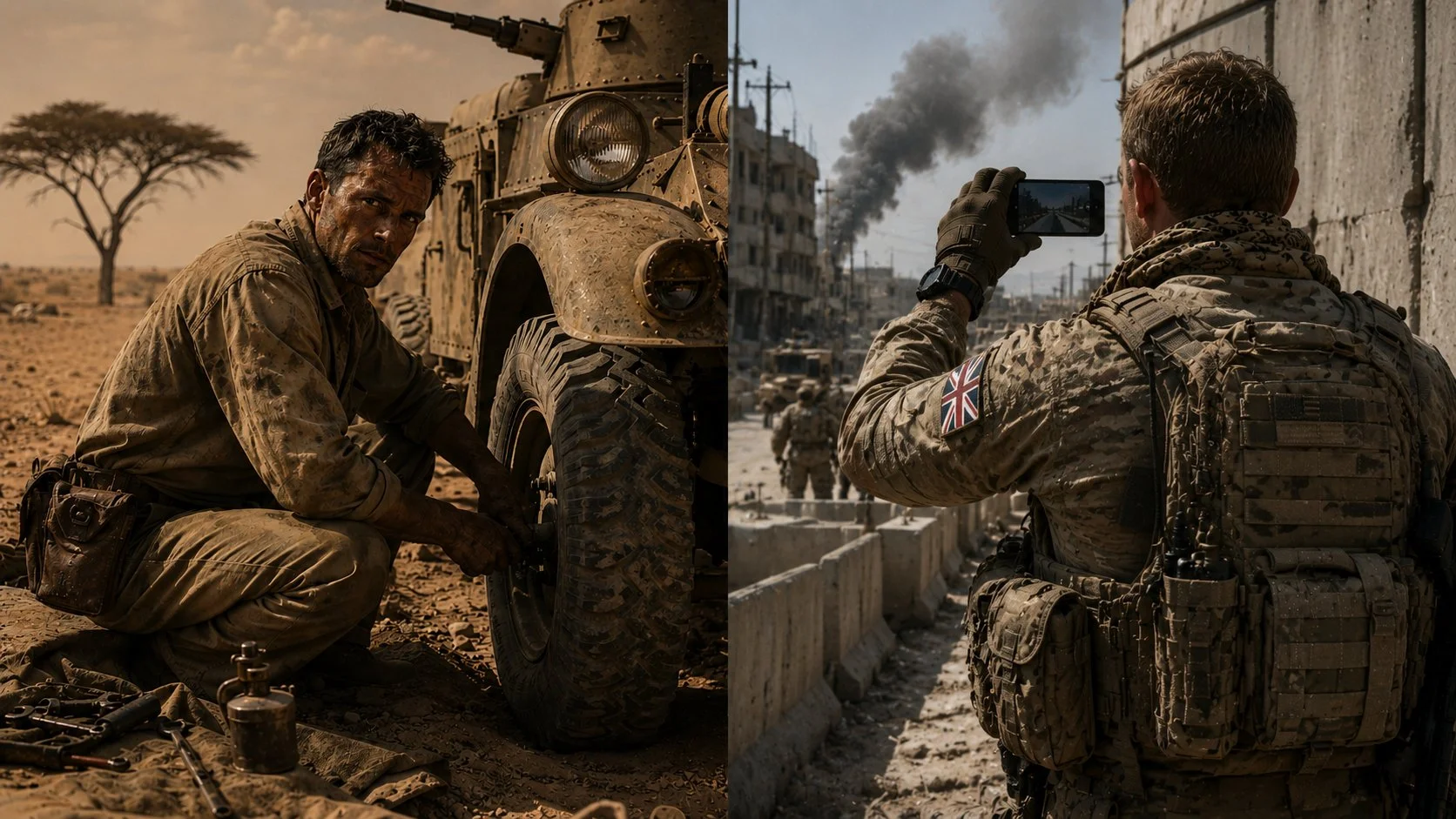
In 2014 I read a Wilbur Smith novel called Cry Wolf. I got the title wrong for years, kept calling it Cryfox in my head, which makes sense because he also wrote Golden Fox and the two titles blurred together. The book itself I remembered clearly though. A rugged Texan mechanic named Jake Barton and a smooth British hustler named Major Gareth Swales end up smuggling a fleet of ancient armored cars into Ethiopia in 1935 to help the royalists hold off Mussolini's invading forces. Desert crossings, tribal betrayals, Italian bombers overhead, jury-rigged vehicles held together by stubbornness and mechanical genius. Classic Wilbur Smith.
I finished it, thought it was excellent, and moved on with my life. The book sat somewhere in the back of my head for the next seven years.
August 2021A Facebook Live from Kabul
In August 2021 I started following a British ex-Royal Marine named Paul "Pen" Farthing on Facebook. The Taliban had just taken Kabul far faster than anyone expected, and Pen was trapped inside the city running a live commentary of what was happening around him. He had a dog and cat rescue charity called Nowzad, hundreds of animals under his care, and a small team of Afghan veterinary staff. He refused to leave without all of them.
I watched those updates minute to minute. He was posting from inside the Kabul perimeter, describing Taliban checkpoints, trying to get a private cargo plane cleared for landing, fighting a very public political battle back home in the UK where the Ministry of Defence was reluctant to help. He was exhausted, sun-baked, completely done with bureaucracy, and absolutely not going to back down. The whole thing was raw and unfiltered in a way that news coverage never is.
And then it hit me. I was watching Jake Barton. Not a character who reminded me of Jake Barton. I mean I was looking at the actual archetype that Wilbur Smith had built his hero on, playing out in real time on my phone screen in 2021.
It felt like time travel. I had read about this person in a 1976 novel, and here he was, operating in a completely different century, in a completely different war zone, with the same stubborn energy, the same impossible logistics problem, and the same refusal to abandon the mission.
Why Jake Barton and Pen Farthing are the same person
On the surface these two have nothing in common. One is a fictional Texan engineer from the 1930s. The other is a real British Marine operating in 21st century Afghanistan. But the more I thought about it, the more the overlap became impossible to ignore.
Both of them ended up in a foreign war zone they had no business being in, and both found their defining moment there. Jake Barton was not an Ethiopian royalist. He had no political stake in the conflict. He got pulled in by circumstance and stayed because of something that looked a lot like personal honour. Pen Farthing was deployed to Helmand Province on a military tour, broke up a street dog fight, and let that one act of decency grow into a decade-long commitment to a country he had every reason to leave behind.
The core of both stories is a seemingly impossible transport mission being carried out against a backdrop of collapsing order. Jake's job was to keep a convoy of museum-piece armored cars moving through desert heat and military blockades while Italian bombers circled overhead. Pen's job in 2021 was to get a private cargo plane into the world's most chaotic airport during an active military withdrawal, loaded with two hundred dogs and cats and a staff of Afghan nationals, while the Taliban took checkpoints one by one outside the perimeter.
In Cry Wolf, Jake stays long after any sensible mercenary would have cut and run. The money was not worth it at that point. He stays because he has made a commitment and because he cannot bring himself to leave people in a bad situation. Pen Farthing, when the UK military flights wrapped up and his Afghan staff were still stuck at the gate, did not get on the plane. He stayed and eventually got his people out overland through Taliban-controlled territory into Pakistan. Same pattern, different century.
| Element | Jake Barton (Cry Wolf, 1976) | Pen Farthing (Kabul, 2021) |
|---|---|---|
| Origin | Texan engineer, no stake in the conflict | British Marine, no plan to stay after his tour |
| What pulled him in | A lucrative contract to fix armored cars | A street dog fight in Nawzad in 2006 |
| The mission | Move a convoy of ancient vehicles through a military blockade | Get a cargo plane out of a collapsing airport |
| The obstacle | Italian bombers, tribal betrayal, desert terrain | Taliban checkpoints, UK MoD bureaucracy, ISIS-K attack |
| The choice | Stays and fights when all logic says leave | Refuses to board the flight until staff are safe |
| The follow-through | Holds the gorge past the point of reason | Gets 67 Afghan staff out overland through Taliban territory |
He was writing a real archetype, not a fantasy
I think this is the thing that surprised me most. Wilbur Smith grew up in Africa and spent decades observing the kind of men who showed up in conflict zones not as soldiers with orders but as independent operators with a specific skill set and a very personal moral compass. Jake Barton is not a superhero. He is stubborn, practical, sometimes wrong, occasionally selfish in small ways. He is recognisably human. That is what makes him convincing.
Pen Farthing reads the same way. The Facebook Live videos were not heroic in a cinematic sense. He looked stressed and tired and deeply frustrated with everyone who was making his job harder. He was not performing. He was just absolutely committed to a thing and refusing to let go of it. That stubbornness, that specific refusal to accept a bureaucratic wall as a final answer, is the exact quality Wilbur Smith put into Jake Barton fifty years earlier.
Great fiction writers do not invent characters from nothing. They observe a type of person that already exists in the world, strip away the noise, and give you the essential shape of them. When I read Cry Wolf in 2014 I thought Jake Barton was a well-drawn fictional hero. When I watched Pen Farthing in 2021 I realised I had already read his story. The war zone was different. The decade was different. The cargo was animals instead of armored cars. But the person was the same.
The archetypes in good fiction are not invented, they are observed
When a character from a novel feels completely real to you, that feeling is accurate. Somewhere in the world that person exists. Sometimes reality hands you the proof directly, live on Facebook, from the middle of a crisis.
Cry Wolf is not a famous Wilbur Smith book. It is not Shout at the Devil or The Burning Shore. Most people who know his work will not have read it. But if you have any interest in old-school adventure fiction set against real historical conflict, it holds up remarkably well. The 1935 Italian invasion of Ethiopia is one of the most underwritten episodes of modern history, and Smith sets his story right in the middle of it with an accuracy that still surprises me when I go back and check the details.
And if you ever find yourself going down a rabbit hole about Pen Farthing and Operation Ark, I think you will understand exactly what I mean about the time travel feeling. You will be reading a 2021 news story and thinking, I have read this before. I just read it in a 1976 novel, and the main character had a Texan accent.