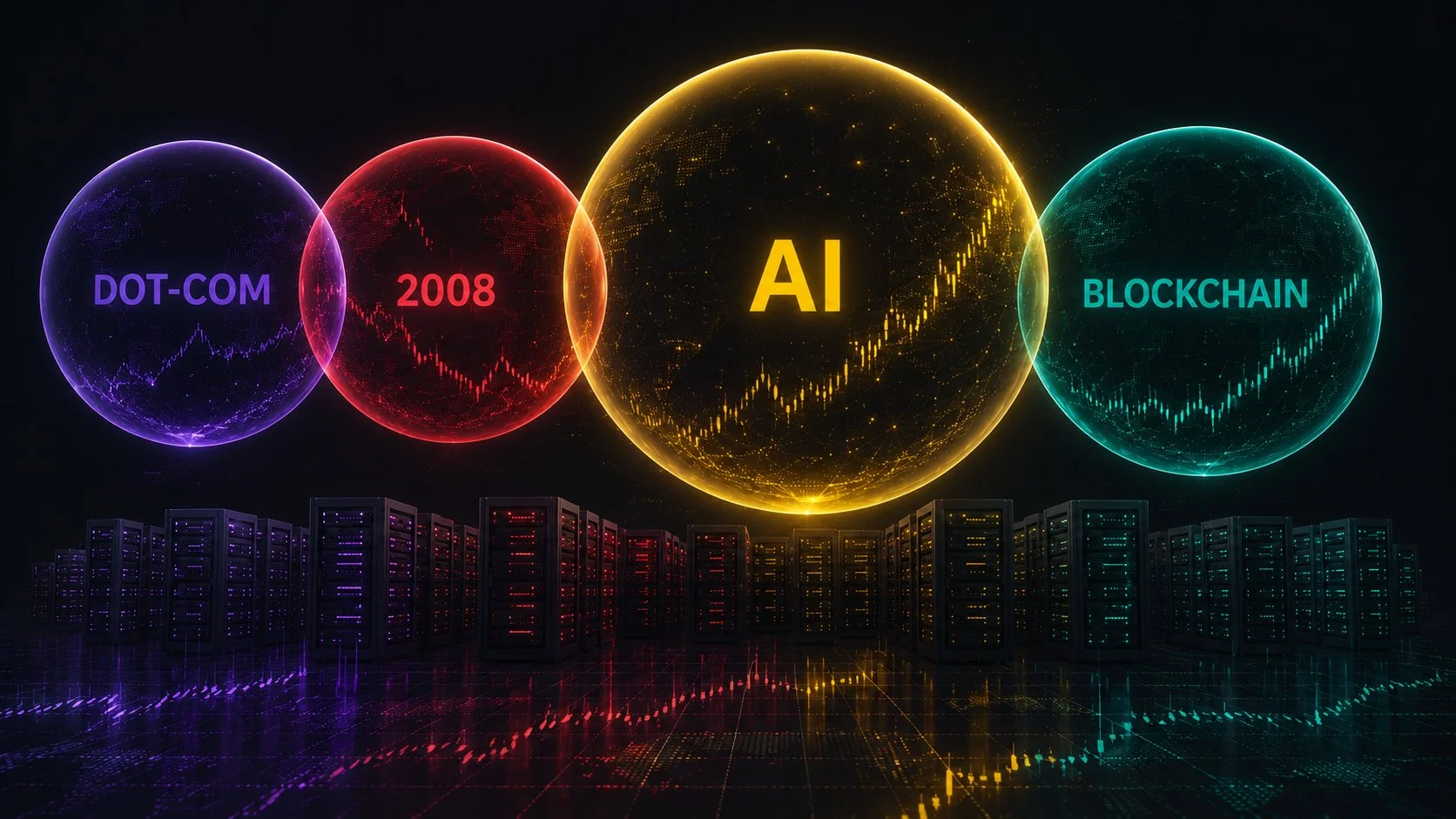
I asked a simple question on a Tuesday night. Was blockchain a bubble? Forty minutes later I was deep into circular funding loops, $120 billion in tech debt, and whether Nvidia chips depreciate faster than a Honda City. I want to walk through what I found, because I think most people are either too dismissive of this AI run or too scared of it, and the truth sits somewhere uncomfortable in between.
Let me lay out where I landed before I get into the weeds. Yes, there is a bubble. No, it will not behave like the ones you remember. And depending on who you are, what you should actually do about it is very different from what the headlines are telling you to do.
Starting pointBlockchain was the easy comparison
Blockchain followed the textbook bubble script. First the hype, somewhere around 2017, when companies started bolting the word "blockchain" onto their name just to watch the stock price jump. Then the mania phase during the pandemic, when DeFi and NFTs turned into a genuine financial frenzy and digital art sold for the price of a house. Then the crash in 2022, when Terra-Luna and FTX wiped out something like two trillion dollars and the whole thing got nicknamed Crypto Winter.
What made it a bubble was simple. People were not buying tokens because they used the network. They were buying because they expected someone else to pay more for it later. That is the Greater Fool Theory in its purest form, and it always ends the same way.
The interesting part is what happened after the crash. Blockchain did not die. It split into two very different things. One half is still pure speculation, memecoins and high volatility trading that will probably never stop existing. The other half quietly became useful. BlackRock, JPMorgan and Citi now use blockchain rails to tokenize bonds and real estate. Stablecoins have become a genuinely better way to move money across borders than the traditional banking system. Supply chain tracking runs on private blockchains at several large manufacturers.
A bubble bursting does not mean the technology was worthless. It means the price stopped matching reality. The technology that survives the crash is usually the part that was solving an actual problem the whole time.
Does AI have the same bubble symptoms?
Once I had the blockchain pattern fresh in my head, I could not stop seeing the same shape in AI. The symptoms line up almost exactly.
Start with the math problem. Tech companies are pouring hundreds of billions into data centers and chips. The revenue coming back from AI products, the actual subscriptions and enterprise contracts, is a small fraction of that spend. Some of the biggest AI labs are running large operating losses and are not projecting profitability for years. That gap between money going out and money coming in is the same gap that existed in crypto, just with far more zeros attached.
Then there is the branding effect. During the blockchain mania, a company could rename itself and watch the stock jump overnight, the Long Island Iced Tea Company turning into Long Blockchain Corp is the textbook example. Today, slapping an AI features layer onto a normal software product does something similar to a valuation, even when there is no real model behind it and no defensible technology.
And then there is the part that genuinely surprised me. Circular funding. Tech giants invest billions directly into AI startups. Those startups then turn around and spend that exact money buying cloud compute and chips back from the same tech giants that funded them. On paper, both sides report rising revenue. In reality, a meaningful chunk of it is one large loop, not new demand entering the system from outside.
AI is not blockchain wearing a new mask
Here is where I had to slow down and stop forcing the comparison, because the differences matter more than the similarities once you look closely.
Blockchain needed users to learn wallets, gas fees, seed phrases and bridges before they could get any value out of it. The day-one utility was close to zero for a normal person. AI has the opposite problem. Anyone who can type a sentence gets value from a large language model in the first thirty seconds. That is a completely different adoption curve, and it changes how a correction would play out. People will keep using AI products even if the valuations crash, because the products already work for them.
The money is also going to a different place. Crypto capital mostly sat in liquid digital tokens that could evaporate in a weekend. AI capital is going into physical infrastructure, data centers, power grids, semiconductor fabrication. That infrastructure does not vanish if a stock price falls. It keeps running. It keeps generating some cash flow, even if the return on that capital ends up disappointing the people who funded it.
Who is funding it matters too. Crypto leaned heavily on retail investors and speculative venture money. AI infrastructure is being funded by the wealthiest companies on the planet, the hyperscalers with enormous cash reserves. That does not make a correction painless, but it does mean the people holding the risk can absorb a much bigger hit without the whole system freezing.
The other comparisonWhat about 2008? This is the one that actually worries me
I expected the blockchain comparison to be the scary one. It turned out the 2008 comparison is the one with real teeth, and not for the reason most people assume.
The eerie part is not the housing market itself. It is the financial engineering underneath it. In 2008, Wall Street used mortgage backed securities and CDOs to disguise risk and make it look like home prices could only go up. Today, the circular funding loop I mentioned earlier does something structurally similar. It makes top line revenue numbers look organic and growing when a real portion of it is tech giants paying themselves through a startup in the middle.
| Factor | 2008 Housing Crash | Current AI Boom |
|---|---|---|
| Who holds the debt | Fragile subprime borrowers | Cash-rich hyperscalers |
| Nature of the asset | Non-productive, value relied on belief | Productive, generates compute revenue |
| Where risk sits | Hidden across global retail banks | Concentrated in equity and VC investors |
| Asset lifespan | Physical homes, decades of use | Chips obsolete in 3 to 4 years |
| System-wide contagion risk | Froze global credit markets | Largely contained to tech sector |
That asset lifespan row is the one that stuck with me the most. When the housing bubble popped, the houses did not disappear. They were still physical buildings that people eventually moved into. An Nvidia chip bought this year is a different kind of asset. It depreciates fast, and newer architecture can make it outdated within three to four years. If the revenue to justify that spend does not show up quickly enough, companies will be writing off enormous amounts of hardware that simply stopped being competitive. Michael Burry, the investor who famously called the 2008 crash, has pointed at exactly this depreciation risk in AI infrastructure spending.
So the honest answer to "is this like 2008" is partial. The financial engineering rhymes. The actual systemic risk does not, because the global banking system is not the one holding this debt the way it held subprime mortgages. A correction here would hurt tech stocks and Silicon Valley jobs badly. It would not freeze the world's credit system the way 2008 did.
This looks more like the Dot-Com crash than 2008
Real infrastructure being built on top of speculative valuations, the same way fibre optic cable from the late nineties ended up powering the internet we use today, long after the companies that laid it went bankrupt. The froth clears. The pipes stay.
What should you do, depending on who you are
This is where the conversation got useful for me, because the right move is genuinely different depending on whether you are a regular employee, someone working in tech, or someone with money in the market.
If you are not in tech or marketsWatch for AI inflation in things you buy every day
The first thing to be careful about has nothing to do with investing. Companies are relabelling ordinary products as Smart AI tools and charging a premium for it, when a basic non-AI version does the same job for much less. A washing machine does not need to be AI powered to wash clothes well. Ask yourself what you are actually paying extra for before you buy.
The second thing is job pressure in certain roles. Entry level content writing, basic data entry, simple customer support and standard graphic design are facing real downward pressure right now. If that describes your work or a family member's work, treat it as a clear signal to build a second skill rather than waiting it out.
The third thing is the most obvious but the easiest to ignore. Do not put your savings into random AI themed funds or trending stocks because everyone around you seems to be making money. Retail investors buying in at the peak of a hype cycle are reliably the ones who get hurt when it corrects.
If you work in ITStop writing boilerplate code, start owning systems
This is the section I read most carefully, because it applies to people I know personally. A large share of recent global tech layoffs have explicitly cited AI and automation as the reason for cutting headcount, which tells you this is not a future risk, it is already happening.
If you work at or are interviewing with a company whose entire product is a thin interface wrapped around someone else's AI model, be careful. The moment the underlying model provider ships a native feature that does what your product does, that company's advantage disappears overnight. That is not a hypothetical, it has already happened to several startups.
The safer direction is to move closer to infrastructure or closer to deep domain knowledge. Cloud orchestration, data pipeline engineering, cybersecurity and MLOps are not going anywhere soon. Equally valuable is deep expertise in one industry, healthcare compliance, legacy banking systems, insurance underwriting, anywhere that generic AI cannot easily replicate the context a human has built up over years. Writing basic boilerplate code, on the other hand, is being commoditized fast.
One more thing worth saying plainly. Using AI tools at work is no longer a differentiator. Knowing how to configure, extend or build on top of them is what separates people who are getting ahead from people who are quietly falling behind.
If you investSeparate real cash flow from narrative
If you put money into markets, the job right now is to tell the difference between organic growth and a good story. Look closely at the revenue a company reports. If a meaningful chunk of that revenue comes from a circular arrangement where the company invests in a startup that immediately spends the money back on that company's own cloud or chips, treat that growth with suspicion. It is not the same as a customer choosing to pay for a product they need.
Watch the gap between capital spending and actual subscriber revenue. If that gap does not close meaningfully over the next several quarters, expect large writedowns on infrastructure that ages out faster than expected.
The simplest filter I came away with is this. A company with a price to sales ratio above 20 and no free cash flow is a speculative bet dressed up as a growth stock. A company using AI to genuinely lower its own costs and grow real profit today is a different animal entirely. One is selling a promise. The other is showing you a number.
Where I landThe infrastructure survives even if the valuations do not
I keep coming back to one sentence from this whole exercise. Blockchain was a technology looking for a problem. AI got dropped directly onto problems that already existed and already had budgets attached to them. That is a meaningful difference, and it is the reason I do not think this ends the way crypto did.
That does not mean nothing breaks. Thin wrapper startups will get wiped out. Some hyperscaler will take a large writedown on chips that aged out faster than their models predicted. Stock prices for several companies with no real moat will fall hard, possibly more than once. None of that is fun if you are holding those stocks or working at one of those companies.
But the data centers will keep running. The chips, even the outdated ones, will keep doing useful work somewhere. The people who learned to build real systems on top of this technology, rather than just riding the hype around it, will be fine on the other side. That is roughly how the Dot-Com crash worked out too. Pets.com disappeared. The fibre cable stayed in the ground and quietly carried the next twenty years of the internet.
I am not a SEBI-registered financial advisor and nothing here is investment advice. This is me thinking out loud after a long conversation with an AI tool about another set of AI tools, which I realise is a little funny. Do your own research before making any financial decision.