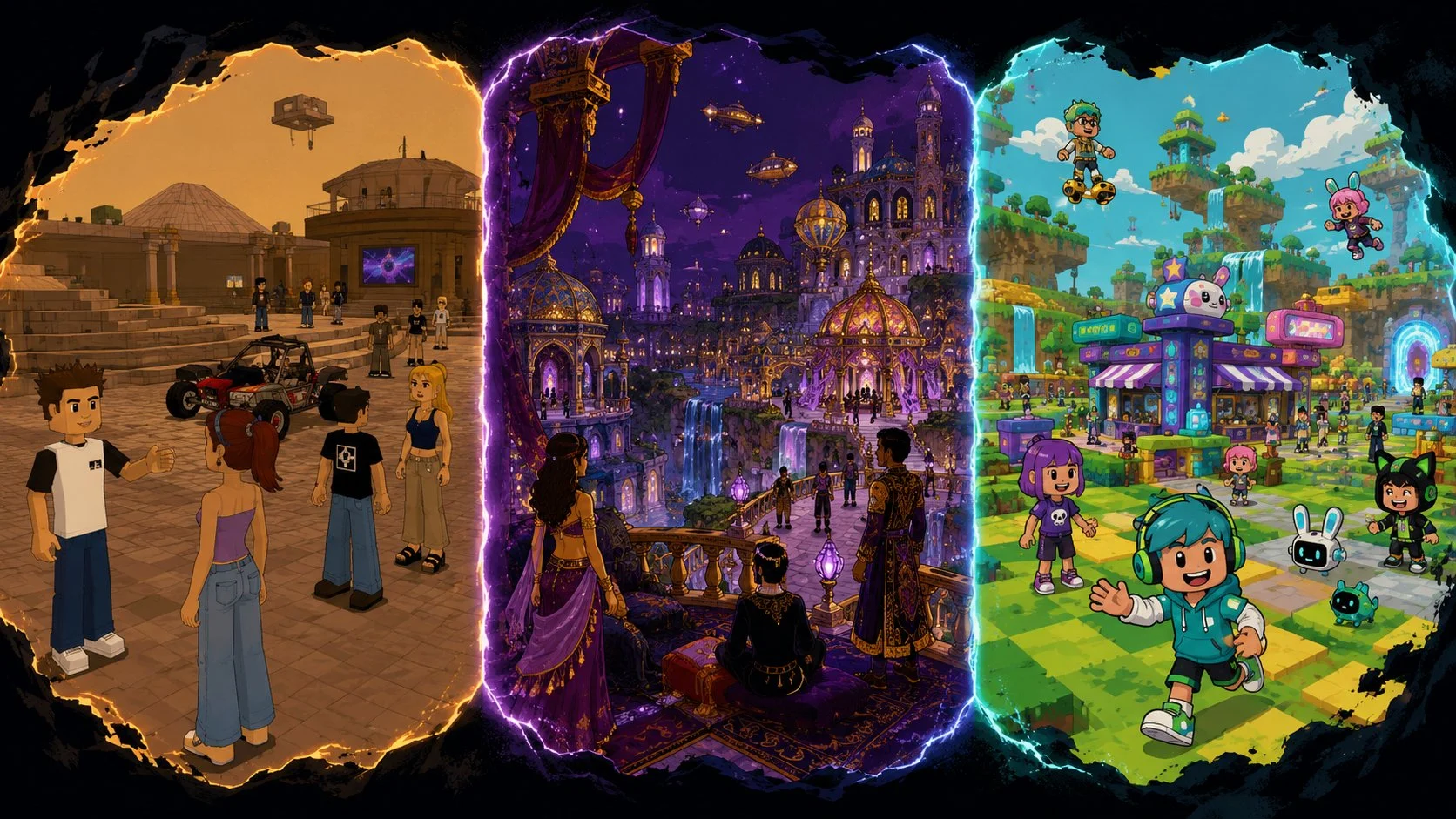
I was having a conversation about virtual worlds and someone asked a question that I could not immediately answer: if you treated There.com, Second Life, and Roblox as three separate nations, what would their GDPs look like? I had to think about it, and when I did, the answer turned out to be far more interesting than I expected.
These three platforms launched within three years of each other. There.com went live in 2003. Second Life also launched in 2003. Roblox came in 2006. All three let you create an avatar, move around a virtual space, and interact with other people. On paper they are the same category of product. In practice they are completely different beasts, built for different purposes, serving different people, and generating vastly different amounts of real money.
What I find genuinely fascinating is that all three are still running. I assumed at least one of them had gone dark years ago. None have.
Same era, completely different trajectories
To understand why the economies diverged so dramatically, you have to understand what each platform actually is. They are not really competing products in the way that people assume.
There.com
There.com is a place to hang out. That is not a dismissal; it is a precise description. You drive buggies, go to themed club events, chat with other people, and drift around a pleasant 3D world. There is no game loop. No goal. It is a social space designed around casual interaction. The platform shut down in 2010 due to financial problems, came back in 2012, and then something unexpected happened in 2025: a YouTube documentary about someone spending 30 days in a "dead" MMO went viral. Fourteen million views. A wave of new users showed up. The community, which had been a quiet holdout of older nostalgic players, suddenly had to absorb a surge of curious newcomers. By any economic measure, There.com's annual transaction volume sits somewhere around two million dollars. The currency is Therebucks. Almost no one cashes out to real money. The economy is mostly closed, small, and entirely community-driven.
● Equivalent to Tuvalu or MontserratSecond Life
Second Life is harder to explain to someone who has never used it because it resists simple categorisation. It is not a game. It is not social media. It is a vast digital continent where everything you see was built by a user. The land, the buildings, the clothing, the animations, the vehicles. All of it. The platform has an open economy powered by the Linden Dollar, which trades on a real market exchange called LindeX and converts directly into US dollars. People have been making genuine livelihoods inside Second Life for over two decades. Digital real estate developers, virtual fashion designers, 3D artists, event coordinators. The annual transaction volume sits at roughly 500 to 600 million dollars, all flowing between users. Linden Lab does not make most of that money. The residents do. That is what makes it unusual. It is an economy built almost entirely by its citizens.
● Equivalent to Samoa or TongaRoblox
Roblox is not really a virtual world in the same sense as the other two. It is a game creation and distribution platform. You do not inhabit a single shared space. You jump between thousands of entirely separate games, each built by independent developers using Roblox Studio and the Luau programming language. The economics here are staggering. In 2025, Roblox reported bookings of around 6.8 billion dollars. Its top 1,000 creators earn an average of 1.3 million dollars a year each. Nike, Gucci, and Adidas run storefronts inside it. This is no longer a platform where individual hobbyists putter around. It is an industry. The currency is Robux, bought with real money, convertible back to real money for top-tier creators through a program called Developer Exchange.
● Surpasses GDP of Fiji, Barbados, and MontenegroPurpose shapes economy
The economic divergence is not random. It maps directly to what each platform set out to do.
There.com was built for socialising and never tried to be anything else. It has a small, loyal community that enjoys what it offers. That is a success of sorts, but it does not generate an expansive economy because there is no engine for one. You can sell digital clothing or rent a small plot. That is roughly the ceiling.
Second Life gave users the ability to build anything and sell it to anyone, with a convertible currency from day one. That single design decision created an entire class of digital entrepreneur that did not exist before 2003. The platform is now old enough that some of its virtual real estate developers have been running their businesses for fifteen to twenty years. The economy is mature, relatively stable, and surprisingly resilient for something built on a 2003 game engine.
Second Life's economy has been quietly generating half a billion dollars a year in user-to-user transactions for well over a decade. Most people in tech assume it died around 2010. It did not. It just stopped being interesting to journalists.
Roblox succeeded because it solved a different problem entirely. It gave young developers a complete game creation pipeline, a massive built-in audience, and a monetisation layer on top. The result is something closer to an app store than a virtual world. Each "game" inside Roblox is its own economy. Add all of them up and you get a number that is genuinely difficult to comprehend for a platform that started as a physics sandbox for children.
Side by sideThe comparison in numbers
| Platform | Launched | Annual Economy | Currency | Real Cash-Out? | Primary Activity |
|---|---|---|---|---|---|
| There.com | 2003 | ~$2 million | Therebucks | Minimal / No | Casual social hangout |
| Second Life | 2003 | ~$550 million | Linden Dollar (L$) | Yes — via LindeX | User-built world and commerce |
| Roblox | 2006 | ~$6.8 billion | Robux | Yes — via DevEx | Game creation and publishing |
Will people actually live inside these platforms?
I think the framing of "living inside a virtual world" is slightly wrong. The more honest version of the question is whether digital identity, digital income, and digital assets will carry the same weight as physical ones. And that is already happening for a subset of people.
On Roblox, there are development studios of twenty people running as proper businesses, with HR and salaries and revenue targets, whose entire output exists only inside the platform. In Second Life, there are people whose primary income for fifteen years has come from renting virtual land they never physically touched. These are not edge cases. They are small but real economies.
What probably will not happen is the single unified metaverse that science fiction promised. The internet itself is fragmented across platforms that do not talk to each other. Virtual economies are going the same way. Roblox, Second Life, Fortnite, and whatever comes next will each have their own currency, their own creators, and their own rules. The money will flow inside each ecosystem, not between them.
There.com does not fit neatly into any prediction about the future of digital economies. It is too small and too nostalgic for that. But I find it oddly endearing that it still exists. A tiny island nation of a few thousand people who just genuinely like each other's company and drive buggies around a 2003-era 3D world. Not everything digital needs to be a billion-dollar platform to be worth something to the people inside it.
Design determines destiny in virtual economies
There.com built for socialising. Second Life built for ownership. Roblox built for creation and distribution. Those three decisions, made in the early 2000s, explain almost the entire difference between a $2 million economy and a $6.8 billion one. The lesson is not that bigger is better. It is that what you build for matters more than almost anything else.