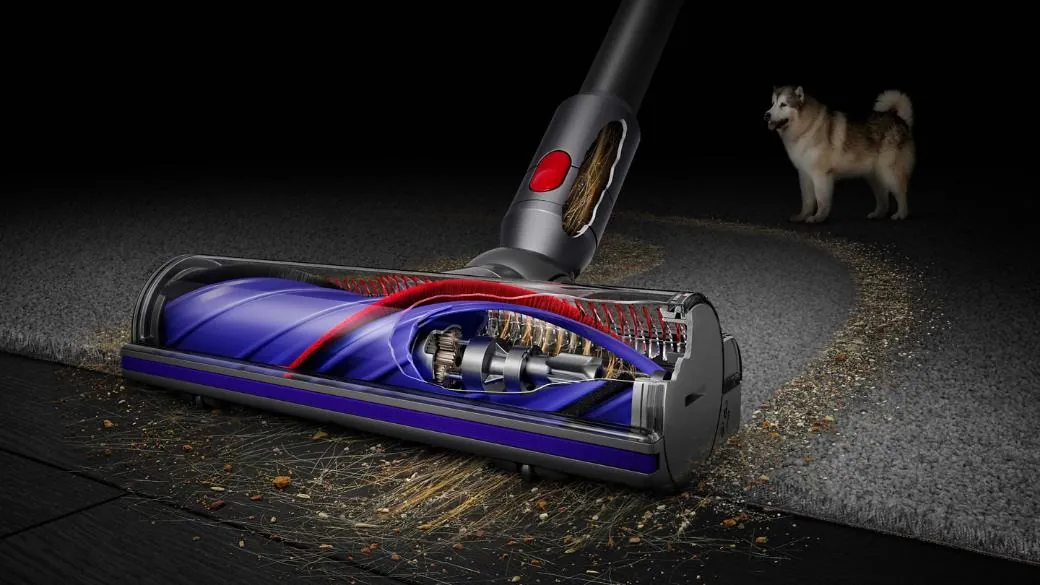
The Dyson V8 — lighter than it looks, louder than expected.
The box arrived in the morning. I plugged in the Dyson V8, tested it for about fifteen seconds on the living room floor, and then immediately had a question: how long does the first charge need to be? I assumed five minutes on Google would sort it. Instead I ended up in a two-hour conversation with Gemini that went somewhere I did not expect.
The short answer on charging is below. But along the way I learned things about Dyson the company that I found genuinely interesting, so I am writing all of it down here.
The practical part firstHow long to charge a Dyson V8 the first time
Five hours. Leave it on the charger for the full five hours, even if the indicator lights go dark before that. Dyson says this gives the battery management system time to calibrate properly, which matters for how much runtime you get out of the machine over its life.
I had run the thing for about fifteen seconds before plugging it in. I asked if that was a problem. It is not. The calibration process does not care what state the battery was in before you started. Just plug it in and leave it alone for five hours.
Charge for the full 5 hours
Even if the lights go off earlier, keep it plugged in. This first cycle calibrates the battery cells and sets the baseline for runtime going forward.
The blue lights will pulse while charging
When the battery is full, they go solid for a moment and then go dark. That is normal. The charger stops drawing power automatically once it hits 100%.
Let it cool before recharging after heavy use
If you run it on Boost mode until the battery dies, give the machine a few minutes to cool down before plugging it back in. Charging a hot battery shortens its overall life.
The history I did not expect to find
Where Dyson actually comes from
I knew it was a British brand. What I did not know was the specific story behind how it started, and it is a better story than I expected.
James Dyson was a designer in his thirties living in Wiltshire, England. He got frustrated with his vacuum cleaner losing suction. That is the kind of problem most people complain about and forget. Dyson decided to fix it. Over five years he built 5,127 different prototypes in a shed behind his house, trying to make a cyclonic system that did not lose suction as it filled up.
He finished the prototype in 1979. Then he spent years trying to sell the idea to British and American manufacturers. Nobody would buy it. The reason was simple: vacuum bag sales were a huge and steady revenue stream for those companies, and a bagless vacuum threatened all of it. So they passed.
1979, Wiltshire, England
The shed
James Dyson completes his 5,127th prototype of a cyclonic bagless vacuum cleaner after five years of iteration.
1985, Japan
The G-Force
With UK and US manufacturers refusing to license the technology, Dyson licenses it to a Japanese company instead. The G-Force sells in Japan for $2,000. The royalties fund his next move.
1991, Malmesbury, England
The company
Dyson founds his own manufacturing company in Malmesbury, Wiltshire and begins making vacuums himself.
2002, Malaysia
The controversial move
Dyson closes its UK factory and moves all production to Malaysia, relocating 800 jobs. The engineering and design teams stay in England.
2019, Singapore
The global HQ
Dyson moves its corporate headquarters to Singapore, into a converted historic power station. The UK campuses remain for research and engineering.
What I find interesting about the Japan chapter is that Dyson had to go east to find a market willing to pay for the technology that British companies refused to make. The G-Force sold for the equivalent of $2,000. In 1985. And it was pink and designed to double as a coffee table for small Tokyo apartments. That is a very specific product, and it worked.
Made in — where, exactly?
Why your Dyson was built in Malaysia
The V8 I bought came from Malaysia. I did not know that before I looked it up. Dyson used to manufacture in Wiltshire, where the company started. In 2002 they closed that factory and moved everything to Southeast Asia. About 800 people lost their jobs in the UK. At the time it caused a significant amount of public anger, especially because Dyson had received government support and had positioned itself as a British manufacturing success story.
The company said the move was about staying competitive and being closer to its supply chain. That is probably true. It is also not the kind of explanation that lands well with the people whose jobs just went to another continent.
| Country | What is made there |
|---|---|
| Malaysia | Final assembly of cordless vacuums, fans, hair dryers. The main production hub. |
| Singapore | Dyson's digital hyperdymium motors, manufactured in automated facilities. These are the high-precision components that go inside the vacuums and hair care products. |
| Philippines | Additional assembly lines for vacuum cleaners and hair care, managed through manufacturing partners including New Kinpo Group. |
| United Kingdom | Research, engineering, and design. Campuses in Malmesbury and Hullavington Airfield. No manufacturing since 2002. |
This is a pattern that repeats across premium engineering brands. The design and the brand story live in one country. The actual factory lives somewhere else. Dyson is not unusual in this. It is just more visible because the gap between the brand story and the reality is fairly wide.
Dyson's digital motors are made in Singapore, not Malaysia. The motor inside your V8 specifically was precision-built in a fully automated facility in Singapore before being shipped to the Malaysian plant for final assembly.
While I was down this rabbit hole
Dyson makes headphones now


I came across this while researching the vacuum and I had to look twice. Dyson makes over-ear headphones. Two models. The OnTrac is audio-only with active noise cancellation, and it starts at around Rs 26,900 in India. The Zone is the strange one: it has a built-in two-stage air purification system with a magnetic visor that filters city air as you listen. That one starts at Rs 59,900.
I am not sure how many people need filtered air piped directly into their face while also listening to music. But it exists, and knowing Dyson's history of solving problems no one asked them to solve, I am not surprised they built it.
My V8 is now fully charged and sitting in the corner. It took five hours and fourteen minutes, which I know because I timed it out of curiosity. The thing I did not expect from buying a vacuum cleaner was to spend an afternoon learning about a man who built 5,127 prototypes in a garden shed and eventually moved his entire company to Singapore. That is what happens when you ask simple questions and keep following the answers.
A similarly confusing topic, broken down cleanly. Which apps work, what to pay, and whether a VPN is worth it.
Quick answers
Five hours. Dyson recommends this for the first charge to allow the battery management system to calibrate fully. The indicator lights may go dark before the five hours are up, but keep it plugged in regardless. This sets the baseline for how much runtime the battery delivers going forward.
James Dyson founded the company in Malmesbury, Wiltshire, England in 1991, after spending five years building prototypes in a shed behind his house. The company's roots are entirely British. Today the global corporate headquarters is in Singapore, but the research and engineering campuses remain in the UK.
Most Dyson vacuums are assembled in Malaysia. The precision digital motors inside them are made in Singapore. Additional production runs in the Philippines through manufacturing partners. Dyson closed its UK factory in 2002, moving about 800 jobs to Malaysia. The UK sites now handle only research, design, and engineering.
Yes. Running the machine for a few seconds to test it before charging has no effect on the first charge cycle or on battery health. The five-hour first charge is about calibrating the battery cells, not about recovering from a depleted state. Just plug it in after your test run and leave it for the full five hours.
The Dyson Zone is an over-ear headphone with a built-in two-stage air purification system. It includes a magnetic visor that attaches to filter urban pollutants and deliver purified air directly to your nose and mouth while you listen. In India it starts at around Rs 59,900. Dyson also sells the OnTrac, an audio-only model with active noise cancellation, starting from around Rs 26,900.