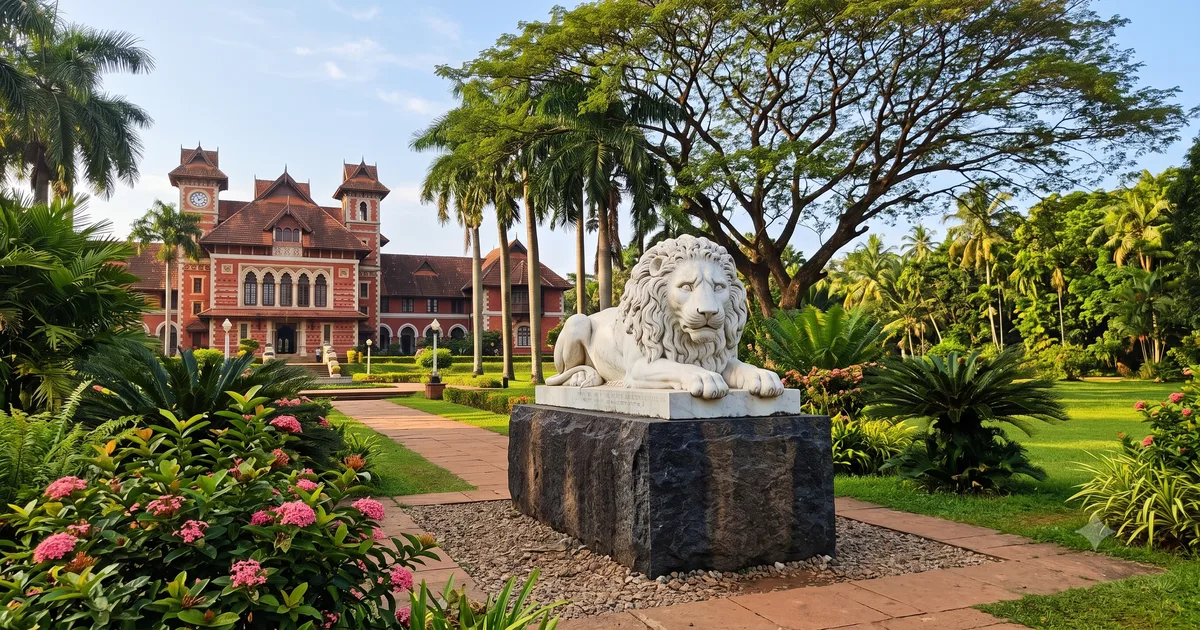
There are two white marble lions sitting in the Kanakakunnu Palace grounds in Trivandrum. They are large, detailed, and clearly not local. The mane is carved in thick curling spirals. The eyes have an almost unsettling amber quality. The posture is that classical recumbent lion pose you see in front of important buildings across the world, head resting on crossed paws, watching everything.
I have walked past them multiple times without giving much thought to where they came from. This morning I finally stopped and read the inscription carved into the base. Three lines in Italian:
STUDIO DI GREGORIO ROACULI
TOSCANA PIETRASANTA
The lions were made in Pietrasanta. That is a town in Tuscany, in the Versilia coastal strip between Viareggio and La Spezia, at the foot of the Apuan Alps. The same mountains that supplied marble to Michelangelo. The workshop that made them was run by someone named Gregorio Roaculi, and they were sold for export under the banner Commercio d'Italia, which translates roughly as Italian Trade. This is not a legendary studio whose name I could trace anywhere obvious. It is a commercial marble workshop of the kind that Pietrasanta has had for centuries, producing ornamental sculptures for clients around the world.
The marble capital of EuropeWhy everything came from Pietrasanta
Pietrasanta has been carving stone since the 14th century. The Apuan Alps directly behind the town produce some of the finest white marble in the world, and the town built an entire economy around extracting and shaping it. By the 19th century, Pietrasanta was exporting decorative marble work to clients across Europe, the Americas, and the colonial world. The phrase that appears on the lion base, Commercio d'Italia, signals exactly this export orientation. These were not one-of-a-kind commissions. They were quality catalogue products.
The way it worked in that period was that workshops like the Studio di Gregorio Roaculi would have a range of standard designs, each available in different sizes and finishes. A client, or more likely an agent representing a royal court, would select a design, negotiate the size, and the workshop would carve it from Apuan marble. The finished piece would then be packed and shipped, usually via Livorno or Genoa, to wherever it was going.
By the late 19th century, Pietrasanta had around 55 marble workshops and bronze foundries operating in the area. The town exported decorative sculpture to India, South America, Southeast Asia, and across Europe. The same basic lion design appears in front of palaces and public buildings on multiple continents.
The Travancore court and its taste for European imports
The lions at Kanakakunnu Palace were brought to Trivandrum during the reign of Maharaja Sree Moolam Thirunal, who ruled Travancore from 1885 to 1924. This was a period when Indian princely states, particularly progressive ones like Travancore and Mysore, were actively importing European decorative arts. It was partly about aesthetics and partly about signalling: a kingdom that could commission from Tuscany was a kingdom that participated in the modern world.
Kanakakunnu Palace itself was built during this period to serve as a guest house for foreign dignitaries and a venue for royal state banquets. The name translates as Gold Hill in Malayalam. The palace needed something at the gate that read as both grand and cosmopolitan. A pair of Italian marble lions filled that need exactly.
What makes these particular lions interesting is that they appear at multiple locations around Trivandrum. The white marble pair at Kanakakunnu Palace are the most visible. There are also lions with the same Pietrasanta inscription in the Napier Museum compound, a short walk away. And this morning I found a third set at another palace entrance, these ones painted gold rather than left as bare marble. Same reclining pose, same curling mane, same inscription on the base. The Travancore court clearly ordered more than one pair from the same workshop.
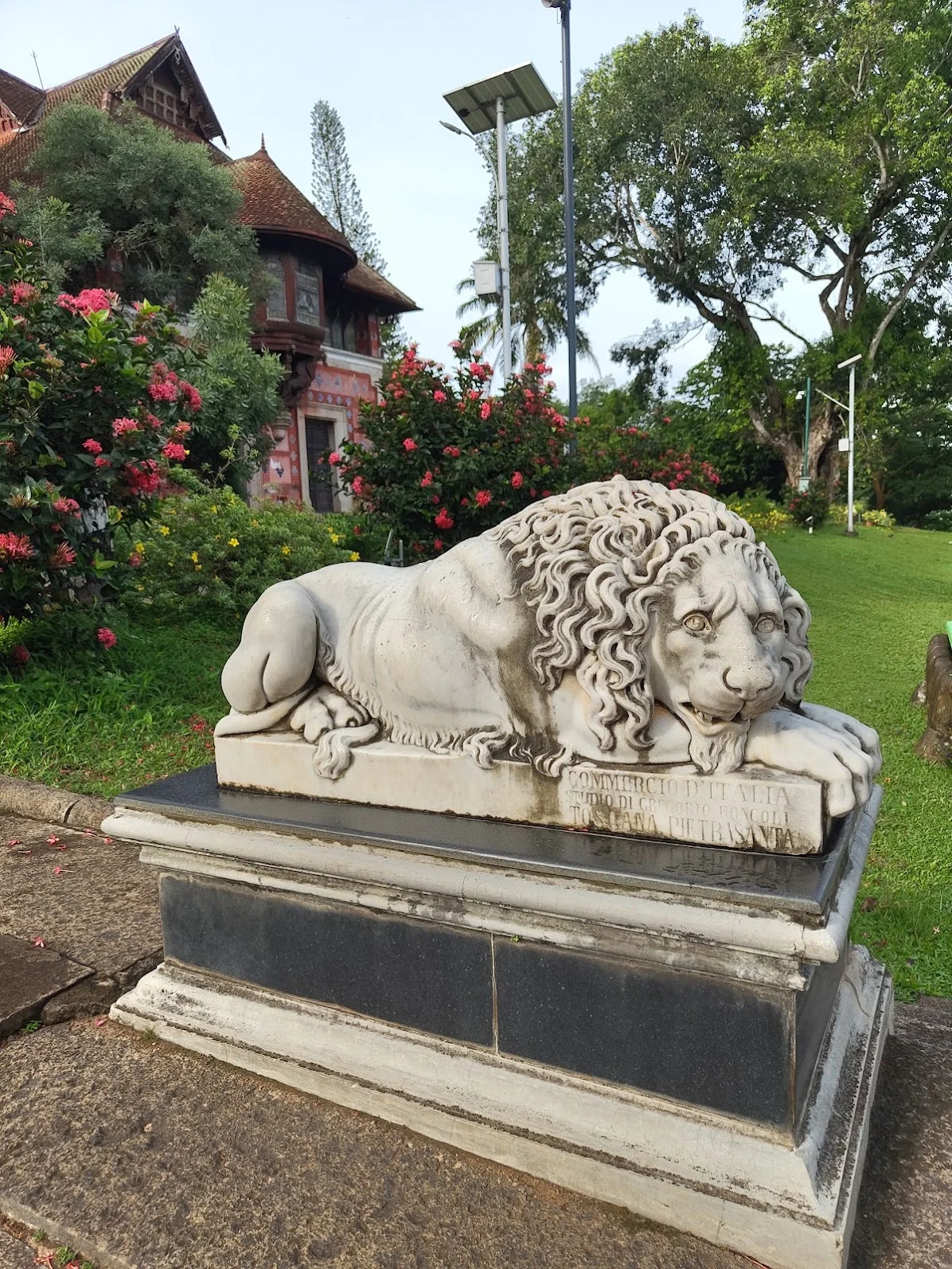
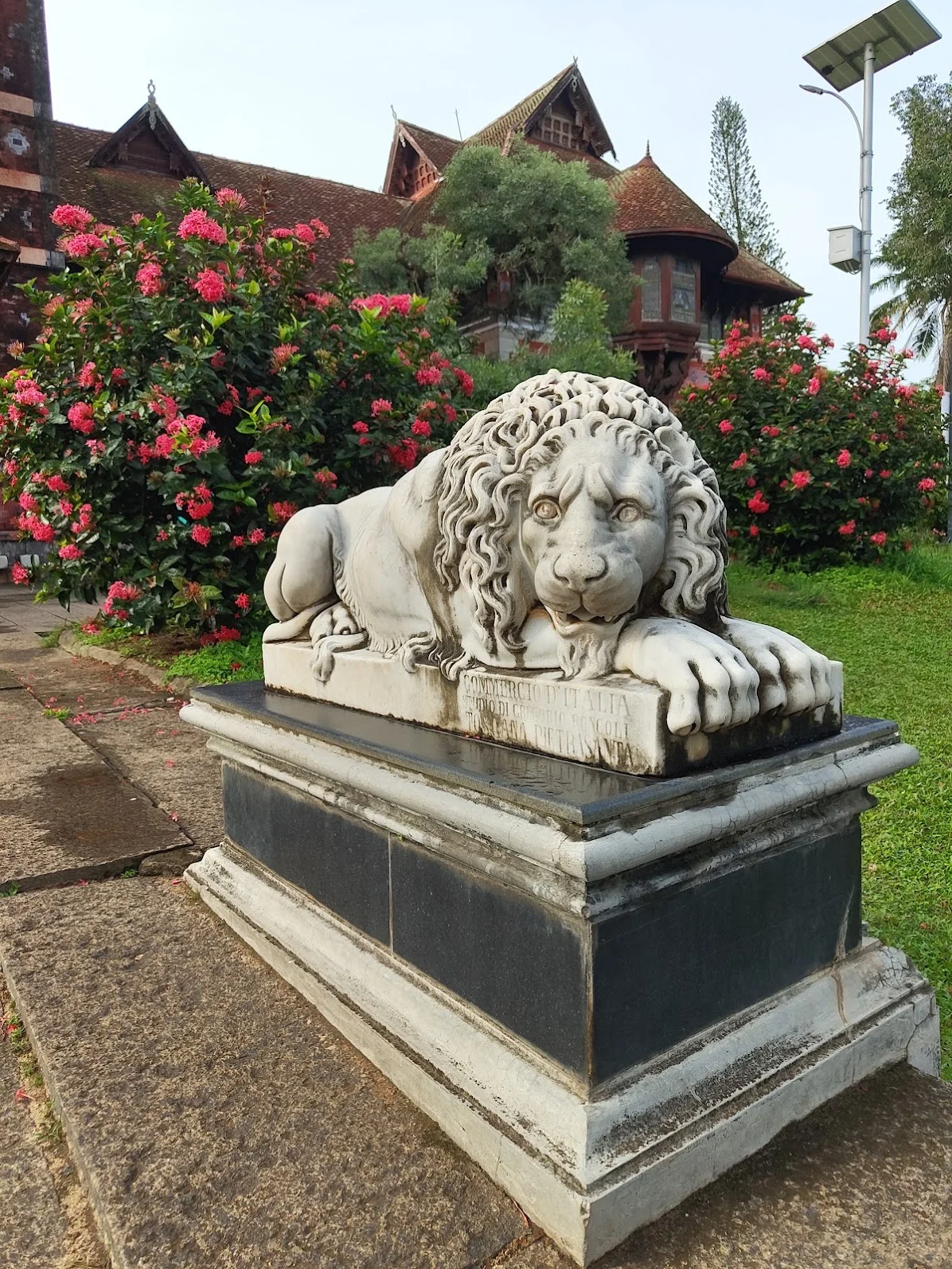
The white marble lions at Kanakakunnu Palace grounds. The inscription is carved into the base: COMMERCIO D'ITALIA / STUDIO DI GREGORIO ROACULI / TOSCANA PIETRASANTA.
The gold lionSame mold, different finish
The golden lion at the third location is the most striking one to look at. It has been painted in a deep amber-gold and sits at the foot of wide stone steps leading up to a pillared entrance portico. The paint has given it an almost temple idol quality that the plain white marble does not have. Someone at some point decided that bare marble was not the right aesthetic for that entrance.
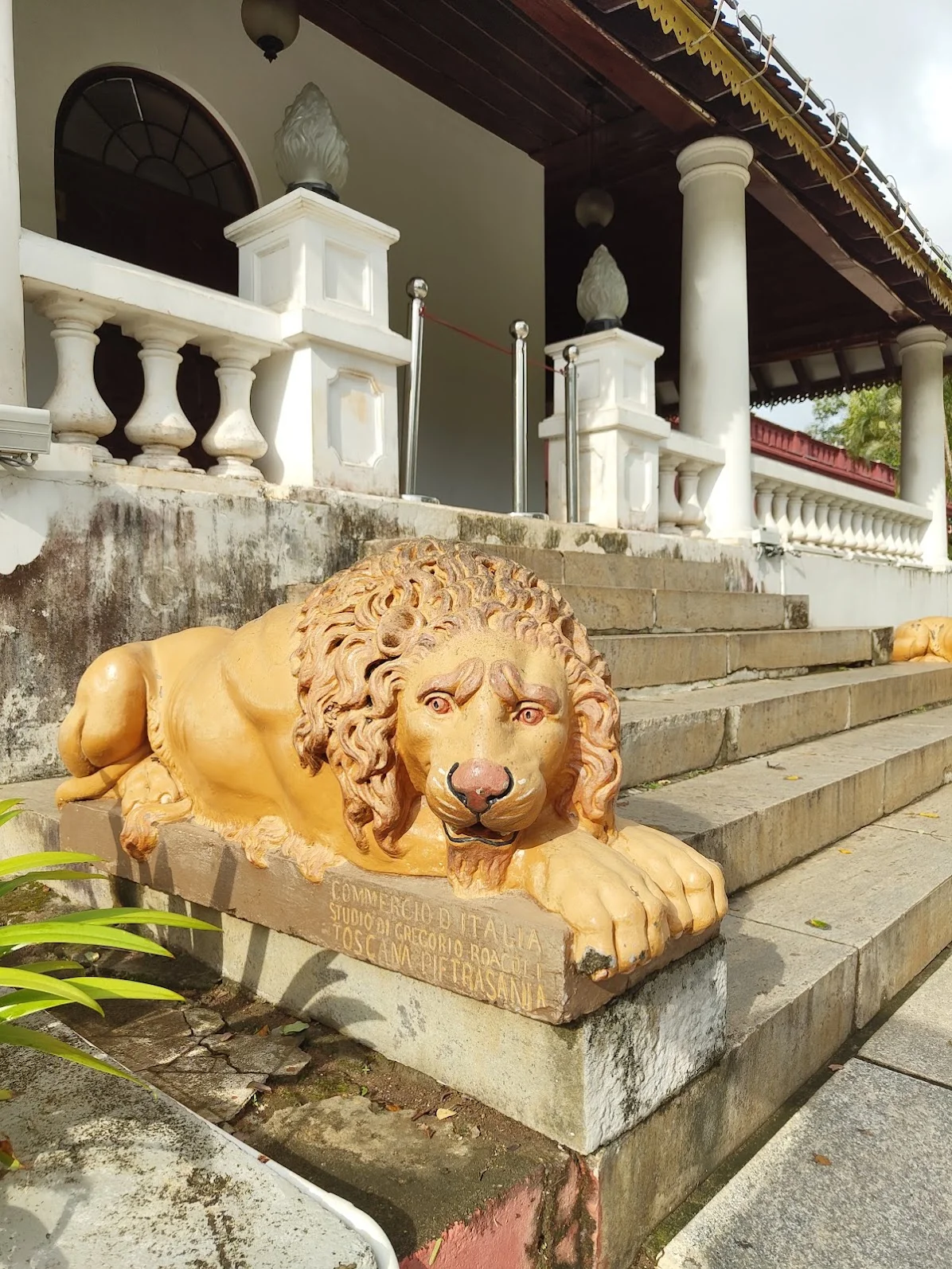
The gold-painted lion at a third Trivandrum location. The inscription is identical. Same workshop, same design.
But the inscription on the base is identical. Same workshop, same design, same Tuscany origin. The only difference is the finish applied locally at some later point. This kind of thing happens a lot with imported objects in Kerala: they arrive as one thing and get adapted into the local visual vocabulary over time.
What the inscription tells usReading "Commercio d'Italia" correctly
The phrase Commercio d'Italia is not the name of a company. It means Italian Trade, or Italian Commerce. It was common practice for Pietrasanta workshops that sold for export to mark their pieces this way, as a country-of-origin brand rather than a studio name. The studio name comes separately: Studio di Gregorio Roaculi. Then the town: Toscana Pietrasanta, which means Pietrasanta in Tuscany.
This combination tells you that Gregorio Roaculi was a commercial marble sculptor in Pietrasanta who sold through an export trade network. His workshop was not producing unique art. It was producing well-crafted, widely sold decorative objects that ended up in gardens, palace entrances, and civic spaces across the world. The lions at Kanakakunnu are almost certainly not the only surviving examples of his work. There are likely identical statues in front of palaces in South America, Southeast Asia, and parts of Europe that bear the same base inscription.
| Inscription element | What it means | What it tells us |
|---|---|---|
| Commercio d'Italia | Italian Trade / Italian Commerce | Country-of-origin export branding, not a company name |
| Studio di Gregorio Roaculi | Workshop of Gregorio Roaculi | The sculptor's studio that carved and finished the piece |
| Toscana Pietrasanta | Pietrasanta, Tuscany | The town; Europe's leading marble sculpture export center in the 19th century |
The Travancore royal family also imported other European decorative objects during this period. The Kanakakunnu Palace interior contains crystal chandeliers and bespoke wooden furniture. The Napier Museum building itself, designed by British architect Robert Fellowes Chisholm, incorporates Mughal, Italian, Chinese, and Kerala architectural elements. The palace gardens were later landscaped by Gustav Krumbiegel, the German botanist I wrote about previously. European presence in Trivandrum's 19th and early 20th century built environment was not an accident. It was policy.
The Napier Museum was built by Maharaja Ayilyam Thirunal in 1880 and named after Lord Napier, the Governor General of Madras. Its architecture was deliberately multicultural, blending Kerala, Italian, Chinese and Mughal elements. The Italian marble lions placed in its compound fit this international aesthetic exactly.
What nobody tells you about these lions
These statues do not have a plaque or a sign. If you walk past them quickly, which most people do, they are just large decorative lions. There is nothing to indicate that they came from a specific town in Tuscany, were carved by a specific workshop, and were shipped to Kerala roughly 130 years ago as part of a deliberate royal aesthetic programme.
That is what I find interesting about them. Not that they are especially rare or valuable, because they are probably not. But that they are sitting here in the Kanakakunnu garden, in the shadow of a Kerala-Gothic red-brick palace, surrounded by ixora shrubs and tropical trees, and they are completely out of their original context in a way that has become invisible through familiarity. They look like they belong here now. They have been here long enough that they are part of the place.
The inscription will tell you otherwise if you read it. COMMERCIO D'ITALIA. Someone shipped these things across the Indian Ocean from Tuscany. That is not a small detail. It is just one that nobody stops to notice.
Common questions