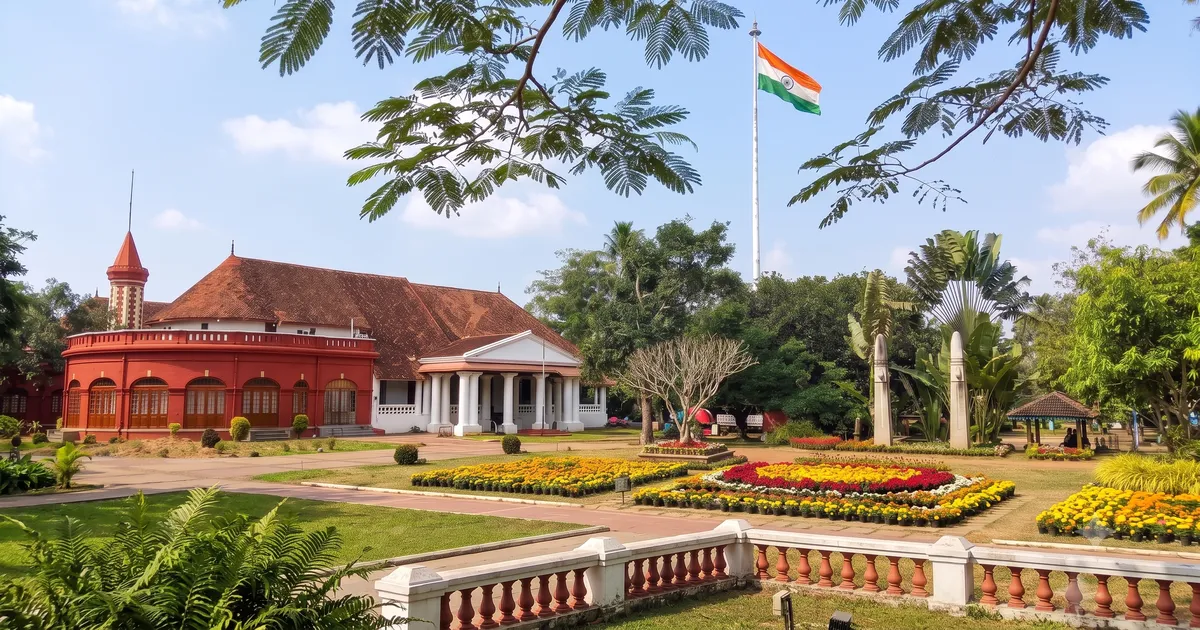
I have driven down Kowdiar Avenue hundreds of times. It is one of those rare stretches in Kerala where the road is actually straight, wide, and lined with trees tall enough to form a canopy overhead. The Kowdiar Palace sits at one end, and Vellayambalam Junction at the other. In between, you pass the Raj Bhavan, old bungalows with compound walls that look strangely uniform, and a sense of order that feels borrowed from some other city entirely.
Someone told me a German designed all of this. Not the buildings. The avenues, the trees, the road alignments, the way the whole stretch holds together. I looked it up expecting to find an exaggerated local legend. Instead, I found Gustav Hermann Krumbiegel.
From Dresden to Baroda to BangaloreThe man who made Bangalore a Garden City before arriving in Trivandrum
Krumbiegel was born in 1865 in Lohmen, a small town near Dresden in what was then the Kingdom of Saxony. He trained in horticulture at Pillnitz, worked as a landscape gardener in Hamburg, and then moved to England in 1888 where he designed flower beds at Hyde Park and joined the staff at the Royal Botanical Gardens in Kew.
In 1893, Maharaja Sayajirao Gaekwad III of Baroda hired him as curator of the botanical gardens there. It was the start of a six-decade relationship with India that would outlast two world wars and multiple regime changes. After Baroda, he moved to Ooty to work on the Government Botanical Gardens. Then, in 1908, Krishnaraja Wadiyar IV, the ruler of Mysore, brought him to Bangalore.
This is where Krumbiegel became famous. He took charge of Lalbagh Botanical Gardens, introduced dozens of ornamental plants and flowering trees, chose the avenue trees that would line Bangalore's roads, and set up India's first horticultural training school. When people call Bangalore the "Garden City," a large part of that trace goes back to this one German botanist who spent over two decades shaping its green cover.
What Krumbiegel actually did in Trivandrum
In 1932, Maharaja Chithira Tirunal Balarama Varma and the Travancore Town Planning Department invited Krumbiegel to Trivandrum. They had seen what he did in Mysore and Bangalore. They wanted him to do something similar for their capital.
Krumbiegel did not redesign Trivandrum from scratch. The city had evolved over centuries under the rulers of Travancore, with the Padmanabhaswamy Temple and the East Fort area forming the old core. What Krumbiegel worked on was the modernisation and beautification of the royal corridors and civic spaces around the palace areas.
| Project | What Krumbiegel did | What exists today |
|---|---|---|
| Kowdiar Avenue | Designed and aligned the stretch from Kowdiar Palace Gate to Vellayambalam Junction; replaced mud boundary walls with uniform stone masonry | One of the widest, straightest tree-lined avenues in Kerala, inaugurated in 1945 |
| Palace gardens | Landscaped the approach roads and gardens for Kanakakunnu Palace and Vellayambalam Palace | Kanakakunnu Palace grounds remain one of Trivandrum's most-used public event spaces |
| Cliff House | Designed the landscaping and approach roads for the estate | Now the official residence of the Chief Minister of Kerala |
| Road alignments | Planned key roads connecting Thampanoor, Pangode, and the Mascot Hotel area | These remain major arterial connections in central Trivandrum |
| Puttarikandam | Recommended transforming it into a structured public open space under a formal town plan | Puttarikandam Maidan is still one of Trivandrum's few large open green spaces |
| Coastal road | Proposed a direct "Marina" road from Shanghumugham Beach to Kovalam | The concept was ahead of its time; parts of this coastal stretch were built decades later |
The detail about replacing the old mud boundary walls along the royal corridors with uniform stone masonry walls is one I find especially telling. It is the kind of move that does not show up in any monument or plaque, but it changes the entire feel of a stretch. That visual consistency along Kowdiar Avenue, where the walls, trees, and road width all work together, is not an accident. Someone planned it ninety years ago.
The Kowdiar Avenue stretch that Krumbiegel designed was formally inaugurated in 1945. The road from Kowdiar Palace to Vellayambalam is still considered one of the few truly straight roads within city limits anywhere in Kerala.
From Kew Gardens to Raj Ghat: a life mapped across six decades
Near Dresden. Trained in horticulture at Pillnitz, then worked in Hamburg as a landscape gardener.
Designed flower beds at Hyde Park and joined the Royal Botanical Gardens at Kew. Studied architecture at Kensington University in his spare time.
Hired by Maharaja Sayajirao Gaekwad III as curator of the botanical gardens. This was the start of 63 years in India.
Invited by Krishnaraja Wadiyar IV of Mysore. Took charge of Lalbagh, chose Bangalore's avenue trees, set up India's first horticultural training school.
Invited by Maharaja Chithira Tirunal. Designed Kowdiar Avenue, palace gardens, road alignments, and the coastal road concept.
Arrested twice, interned in POW camps. His English wife Klara labelled a traitor. The Maharaja of Mysore intervened both times to prevent deportation.
Invited by the Indian government to landscape the memorial gardens for Mahatma Gandhi in New Delhi.
Died on 8 February, aged 90. Buried at the Methodist Cemetery on Hosur Road. His epitaph reads: "Whatever he touched, he adorned."
How a botanist became an enemy of the British Empire
The most striking part of Krumbiegel's life is what happened during World War II. As a German citizen living in British India, he was automatically classified as an "enemy foreigner" when war broke out. The British arrested him twice and placed him in prisoner-of-war internment camps with the intention of deporting him out of India. His wife Klara, who was English, was labelled a traitor by the British authorities for having married a German.
Both times, Krumbiegel's close friend Maharaja Krishnaraja Wadiyar IV and the Dewan of Mysore, Sir Mirza Ismail, intervened on his behalf. They used their political weight to secure his release and block his deportation. For a German botanist in his seventies to survive that era in India required not just luck but people in positions of power who cared enough to fight for him.
After independence in 1947, Krumbiegel chose to stay. India was his home. He had spent more of his life there than anywhere else. He continued working as an independent consultant for various municipal bodies. And then, in what is almost too neat an ending for a real life, the Indian government invited him at the age of 90 to landscape the Raj Ghat memorial gardens for Mahatma Gandhi in New Delhi. A German who had been treated as an enemy by the British was asked to honour the man who ended British rule.
The other foreignerWhy people sometimes confuse Krumbiegel with Laurie Baker
When you say "a foreigner shaped Trivandrum," people often think of Laurie Baker. The confusion is understandable. Both were European-born, both spent their best years in India, and both left a permanent mark on the physical fabric of the city.
But they were very different people working in very different eras.
| Detail | Gustav Hermann Krumbiegel | Laurie Baker |
|---|---|---|
| Born | 1865, Lohmen (Germany) | 1917, Birmingham (England) |
| Profession | Botanist, horticulturist, town planner | Architect |
| Active in TVM | 1932 onwards (visiting consultant) | 1970s onwards (permanent resident) |
| What they shaped | Avenues, road alignments, palace gardens, open spaces | Buildings: CDS, Indian Coffee House, Loyola Chapel, over 1,000 residences |
| Style | Grand, planned, symmetrical; European horticultural principles | Eco-friendly, cost-effective, organic; vernacular Kerala brick |
| Citizenship | German (stayed German his entire life) | Adopted Indian citizenship |
| Died | 1956, Bangalore | 2007, Trivandrum |
Baker is far more famous in Kerala and for good reason. He lived in Trivandrum for over three decades, became an Indian citizen, designed buildings that broke every convention about what architecture should cost, and trained a generation of architects who still practise his methods. His spiral-shaped Indian Coffee House near Thampanoor is probably the most photographed building in the city.
Krumbiegel, on the other hand, left his mark in a way that is easy to miss because it is everywhere. He did not build structures that carry plaques. He designed the space between structures. The width of the avenues, the choice of trees, the alignment of roads, the feel of the royal corridors. You experience his work every time you drive through central Trivandrum, but there is nothing to tell you he was there.
A German did not design Trivandrum. But he gave central Trivandrum its distinctive shape.
Krumbiegel did not lay out a city from zero. Trivandrum's core is centuries older than his visit. What he did was take the royal corridors and civic spaces of a princely capital and apply a level of horticultural planning and spatial order that was rare in India at that time. The grand, green aesthetic of Kowdiar and Vellayambalam, the one that feels borrowed from somewhere else, is his signature. And the fact that it has survived nearly a century of Indian urban development without losing its character says something about how well he did the job.
A grave under an African tulip tree
Krumbiegel died on 8 February 1956 in Bangalore. He was 90. He was buried at the Methodist Cemetery on Hosur Road, and for decades his grave was neglected and forgotten.
In 2016, on the 150th anniversary of his birth, the Karnataka Department of Horticulture restored his tombstone. They placed it beneath an African tulip tree. That felt right. The African tulip is a species Krumbiegel himself introduced to Bangalore's avenues over a century ago. His grave sits near a tree he brought to India from the other side of the world.
There is a road near Lalbagh Botanical Garden called Krumbiegel Road. That is his most visible memorial. But if you have ever walked through Lalbagh, or driven down Kowdiar Avenue, or sat in the gardens at Kanakakunnu, you have already been inside his work. You just did not know his name.
Common questions