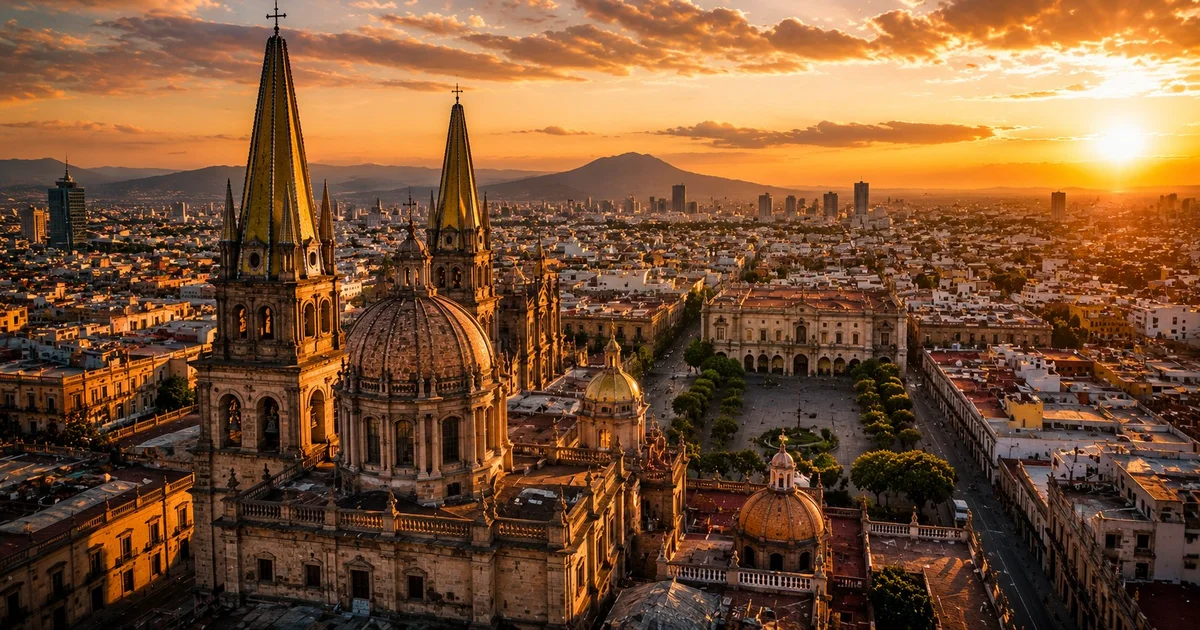
I was talking to Gemini about something unrelated when this question came up: where does the name Guadalajara actually come from? It is not a Spanish word. It sounds vaguely Spanish if you have heard it enough times, but it is not. The answer turns out to be a surprisingly clean example of how languages and empires layer on top of each other over centuries.
Here is the full chain.
Step one — the ArabicIt starts with the Moors
In the 8th century, Arab armies crossed from North Africa and took most of the Iberian Peninsula. They stayed for nearly 800 years. During that time they named rivers, valleys, towns and mountains all across what is now Spain and Portugal. A huge number of Spanish place names starting with "Guad" come directly from this period. Guadalquivir, Guadalupe, Guadiana. They all share the same root.
The Arabic word is wadi, which means a river valley or dry riverbed. When the Arabs named a settlement along a rocky riverbed in what is now the Castile-La Mancha region of Spain, they called it Wadi al-Hijarah. Broken down: wadi means river valley, al is the definite article, and hijarah means stones or rocks. The full phrase translates to "valley of stones" or "river of stones."
8th century Arabic
وادي الحجارة
Wadi al-Hijarah
Valley of Stones
Medieval Spanish
Guadalajara
Castile, Spain
1532 AD
Guadalajara
Jalisco, Mexico
Step two — the Spanish copy
A conquistador names his nostalgia
Fast forward to 1532. A Spanish conquistador named Nuno de Guzman is carving his way through western Mexico, establishing towns and forts as he goes. He was born in Guadalajara, Spain, the city that had evolved out of that original Arabic settlement over the previous 700 years.
When he founds a new settlement in the Jalisco region of Mexico, he does what virtually every conquistador did: he names it after home. This is the same logic that gave us New York, New Orleans, New Delhi, and hundreds of other "New Somethings" across the colonial map. Guzman did not even bother with the "New" prefix. He just called it Guadalajara.
The Spanish city of Guadalajara still exists, about 55 km northeast of Madrid. Population around 80,000. The Mexican one has grown considerably larger since Guzman named it after the Spanish one in 1532.
What the city became
Five million people, one Arabic river valley
5M+
Metro population
2nd
Largest city in Mexico
494
Years old (founded 1532)
Guadalajara is now the second largest city in Mexico, after Mexico City. It is the capital of Jalisco state, which is also where tequila comes from. The city has a strong identity of its own, separate from the capital, and locals are fiercely proud of being from here.
Which brings us to the last piece of the story.
The bonus detail
Why no one calls themselves Guadalajarans
People from Guadalajara, Mexico, are called Tapatio. Not Guadalajarans, not Guadalajarese. Tapatio. The word comes from tapatiotl, a Nahuatl term from the indigenous people of the region. It was originally a unit of exchange used in the local pre-Hispanic markets, something like a standard measure of value. Over time it became associated with the people trading in those markets, and eventually with the city itself.
So when a local says they are Tapatio, they are reaching back past the Spanish colonial name, past the Arabic etymology, all the way to the indigenous Nahuatl that was there long before any of it. That is the thing I find genuinely interesting about place names. The word you say every day might be carrying eight centuries of history you never thought to look at.
Next time someone mentions Guadalajara, you now know it is technically Arabic for "rocky river valley." I find that kind of detail satisfying in a way that is hard to explain.
Quick answers
It means "valley of stones" or "river of stones." The name traces back to the Arabic phrase Wadi al-Hijarah, where wadi means river valley and hijarah means stones or rocks. The Moors named a settlement in central Spain this during their rule of the Iberian Peninsula, and the phrase slowly transformed phonetically into Guadalajara over several centuries of Spanish use.
Yes, entirely. The name has no Spanish root at all. It dates to the Moorish period of the Iberian Peninsula, roughly the 8th to the 15th century, when Arab armies controlled most of what is now Spain and Portugal. They named rivers, towns and valleys all across the region, and Guadalajara was one of them. The Spanish simply kept the name as it evolved in their mouth over time.
The Mexican one was named after the Spanish one. Nuno de Guzman, the conquistador who founded the settlement in Jalisco in 1532, was originally from Guadalajara in Spain. Naming new territories after places back home was standard practice for Spanish colonizers. It is the same reason you have New York, New Orleans, and dozens of other place names that are essentially homesick copies of somewhere in Europe.
Tapatio, or Tapatia for women. The word comes from tapatiotl, a Nahuatl term used by the indigenous people of the region long before the Spanish arrived. It originally referred to a unit of exchange in the local pre-Hispanic markets, something close to a standard measure of value. Over generations it became attached to the people themselves, and then to the city. There is something I like about the fact that the local identity word reaches past the colonial name entirely.
A large number of them, especially anything starting with "Guad." Guadalquivir comes from Wadi al-Kabir, meaning the great river. Guadalupe comes from Wadi al-Lubb, meaning river of black stones. Guadiana is Wadi Ana. Even the name Gibraltar is Arabic: Jabal al-Tariq, meaning the mountain of Tariq, after the general who led the Moorish crossing into Spain in 711 AD. The Arabic footprint on Spanish geography is enormous and mostly invisible to people who have never thought to look for it.