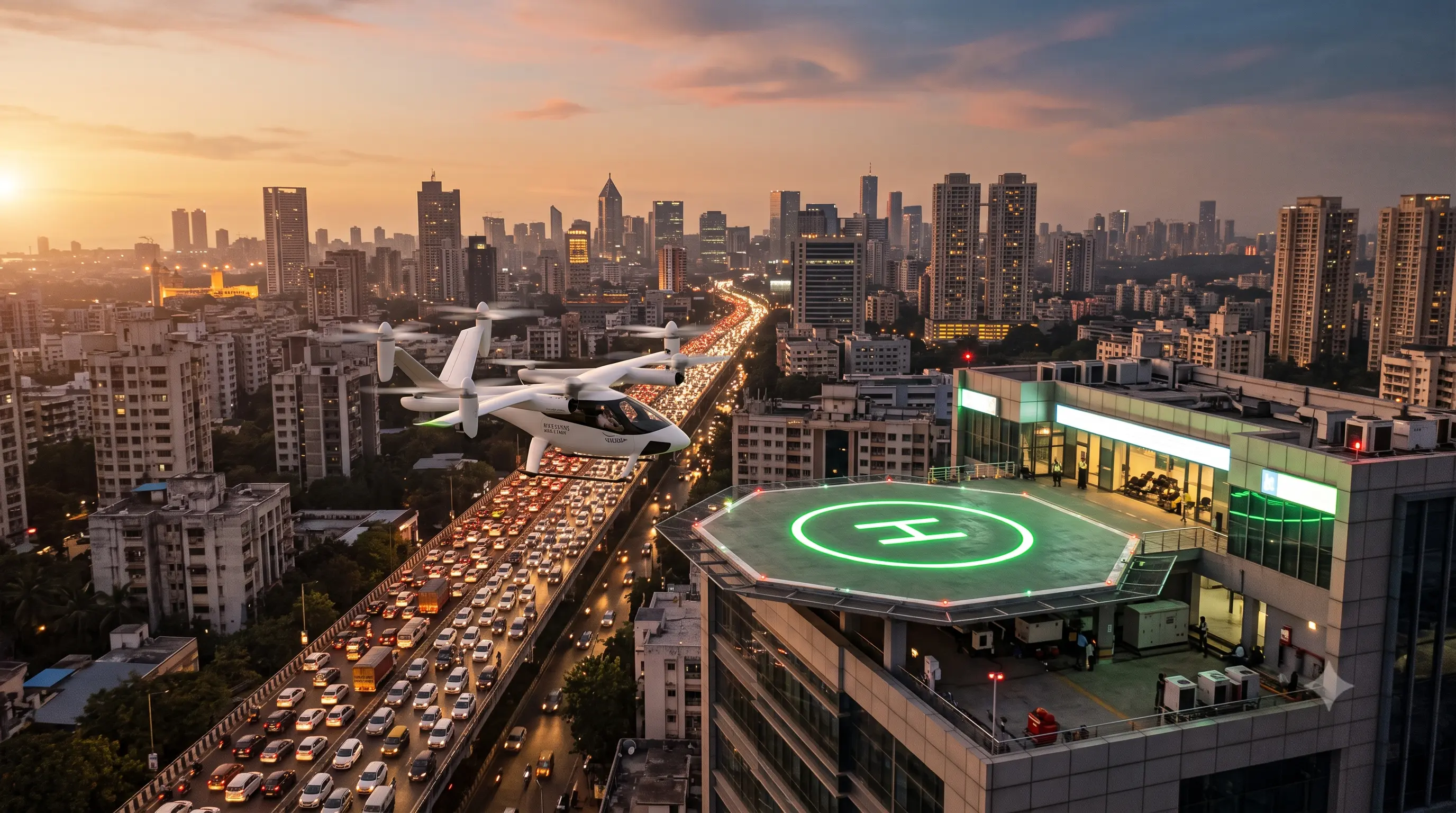
Seven minutes. That is how long it took a Joby Aviation aircraft to fly from JFK Airport to a heliport in Midtown Manhattan on April 27, 2026. The same trip by car takes anywhere from one to two hours depending on traffic. I watched the video, read three different accounts of it, and then spent the next several hours trying to figure out when something like this might happen in India.
The short answer is: it is closer than most people think, but further away than the press releases suggest. Here is what I found.
What we are talking aboutThe aircraft that want to replace your cab
An eVTOL is an electric vertical takeoff and landing aircraft. Think of it as the point where a helicopter and an electric car had a very ambitious child. It lifts off vertically using rotors, transitions to forward flight like a plane, and runs entirely on battery power. No jet fuel. No runway. And compared to a helicopter, roughly a hundred times quieter.
The idea is not to replace planes for long-distance travel. These aircraft are designed for trips of 20 to 100 kilometres. Airport to city centre. One side of Bengaluru to the other. The kind of journey where you currently sit in traffic for ninety minutes and arrive with your sanity frayed.
The three players shaping India's air taxi race
Globally, there are dozens of companies working on eVTOL aircraft. In India, three names come up repeatedly, and they are taking very different approaches.
First, Archer Aviation. This is the American company that partnered with InterGlobe Enterprises (IndiGo's parent) in late 2023 with a plan to bring 200 of its Midnight aircraft to India. The Midnight seats four passengers plus a pilot, can hit 150 mph, and has a range of about 100 miles. Archer completed a 55-mile piloted flight in August 2025 and has been testing at speeds near its maximum. The partnership initially targeted a 2026 launch in India, but that timeline has slipped. Archer is focused on the US and UAE markets first, and the India arrangement was always a memorandum of understanding, not a binding contract.
Second, Sarla Aviation. This is where things get interesting for India specifically. Sarla is a Bengaluru-based startup founded in 2023 that built a half-scale demonstrator in just nine months and unveiled its full-size Shunya prototype at the Bharat Mobility Expo in January 2025. The Shunya seats six passengers plus a pilot, carries 680 kg, and is designed for 20 to 30 km urban hops at speeds up to 250 km/h. IndiGo quietly took a ten crore equity stake in Sarla in early 2026 after the Archer partnership stalled. Sarla has also signed a 1,300 crore deal with the Andhra Pradesh government to build a 500-acre manufacturing campus in Anantapur capable of producing 1,000 aircraft a year.
IndiGo's shift from Archer to Sarla was not a dramatic falling out. Archer's FAA certification timeline pushed back the India launch window, and a non-binding MOU does not lock anyone in. Sarla offered something Archer could not: a platform designed, developed, and eventually certified entirely in India, with lower cost economics built around Indian supply chains.
Third, The ePlane Company. Incubated at IIT Madras, ePlane unveiled India's first full-scale eVTOL prototype, the PT-01, in July 2026 at its new production facility on the IIT Madras Discovery Campus. The aircraft is built on the e200X platform with a range of about 110 km on a single charge. Unlike Sarla and Archer, ePlane is not starting with passenger taxis. It plans to launch with air ambulances first, which is a smart play because hospitals already have helipads, routes are fixed, and emergency transport commands higher fares. In February 2025, the International Critical Air Transfer Team signed an agreement to order 788 eVTOL air ambulances from ePlane. Ground testing begins in 2027, with pilotless flight trials targeted for mid-2027 and commercial operations from 2028.
| Metric | Archer Midnight | Sarla Shunya | ePlane e200X |
|---|---|---|---|
| Origin | California, USA | Bengaluru, India | Chennai, India (IIT Madras) |
| Passengers | 4 + pilot | 6 + pilot | Varies by config |
| Top speed | 241 km/h (150 mph) | 250 km/h | Not disclosed yet |
| Range | ~160 km | Up to 160 km (future battery) | ~110 km |
| India partner | InterGlobe (MOU, stalled) | IndiGo equity stake | ICATT (788 air ambulances) |
| First use case | Urban passenger taxi | Urban passenger taxi | Air ambulance |
| India launch target | 2026 slipped, unclear | Bengaluru, 2028 | Air ambulance, 2028 |
When things will actually happen
There is a pattern I keep seeing in reporting on air taxis. Every article says "launching in 2026" because that is what the press releases said in 2023 and 2024. The reality is more staged, and honestly more sensible for it.
Limited demonstration flights in Bengaluru, possibly Delhi. No paying passengers. This is about proving the aircraft work in Indian airspace and getting DGCA comfortable with the technology.
MoCA finalises the urban air mobility policy. Early vertiports built at airports and business districts in Delhi, Mumbai, and Bengaluru. First type certification applications accepted by DGCA. ePlane begins pilotless flight trials.
Air ambulance services go live first. Passenger routes begin on airport-to-city-centre corridors. Sarla targets Bengaluru. Multiple OEMs enter as certification milestones land.
India transitions from isolated routes to a connected network linking airports, tech parks, business districts, and metro stations. Fares start approaching parity with premium cab services as fleet sizes grow.
Air taxi vs regular cab: the price comparison
The pricing question is the one everyone asks first. The honest answer is that early rides will cost more than a regular cab, but not as much more as you might expect.
Take the Delhi to Gurugram route, the one every company uses in its pitch deck. By Uber Sedan or premium ride-hailing, that costs roughly 1,200 to 2,000 rupees depending on surge pricing and takes 60 to 90 minutes in traffic. An air taxi on the same route is projected to cost 2,000 to 3,000 rupees per seat and take about 7 minutes.
There is a catch. Air taxis charge per seat, not per vehicle. If you are a solo traveller paying 2,500 rupees to save over an hour, that is a strong value proposition. If you are a group of four who would have paid 2,000 rupees total for a cab, the math does not work at all. This is not a budget product. It is a time-saving product aimed at business travellers, airport commuters, and eventually medical emergencies.
| Factor | Premium Cab | Air Taxi (projected) |
|---|---|---|
| Fare | ₹1,200 - ₹2,000 per vehicle | ₹2,000 - ₹3,000 per seat |
| Travel time | 60 - 90+ min (peak traffic) | ~7 minutes |
| Pricing model | Per vehicle | Per seat |
| Capacity | Up to 4 passengers | 4-6 passengers + pilot |
| Best for solo | ₹1,500 avg | ₹2,500 avg (but 7 min) |
| Emissions | Petrol / CNG | Zero direct emissions |
The operating cost argument in favour of eVTOLs is real, though. Electricity costs a fraction of aviation fuel. Electric motors have far fewer moving parts than helicopter turbines, which slashes maintenance costs. Archer has said its per-passenger-mile cost will run between four and five dollars. As fleet sizes grow and battery technology improves, the long-term target is near price parity with premium ride-hailing.
Where they will landVertiports, metro links, and the first-mile problem
An air taxi is only useful if getting to and from it does not cancel out the time you saved in the air. This is where the infrastructure story gets interesting.
DGCA has already published vertiport design guidelines covering everything from landing pad dimensions to charging specifications (minimum 150 kW DC fast-charging per pad) and passenger security screening. The Airports Authority of India has earmarked six sites across Bengaluru, Mumbai, and Delhi NCR for priority vertiport construction.
The placement strategy follows three tiers. Primary hubs go at major airports and business districts. Secondary hubs get retrofitted onto rooftops of large commercial buildings, parking structures, and existing helipads. Suburban feeder nodes sit along major corridors like the Delhi-Gurugram Expressway, letting commuters skip bottleneck zones.
The smarter operators are planning integrated app bookings where one ticket covers the cab to the vertiport, the flight itself, and the metro or auto on the other end. Locating vertiports next to metro stations means passengers can take an elevator from the platform directly to the boarding lounge. That kind of integration is what separates a useful transport network from an expensive novelty.
The regulatory pictureWhat DGCA and MoCA still need to sort out
This is the part nobody wants to talk about in pitch decks, but it is the part that will actually determine the timeline. No aircraft flies commercially in India without DGCA type certification and an Air Operator Permit.
The good news: DGCA has been proactive. Rule 133A of the Aircraft Rules creates a separate "Vertical Take-off and Landing Capable Aircraft" category, which means eVTOLs do not get shoehorned into helicopter or fixed-wing regulations. The Ministry of Civil Aviation draft urban air mobility policy is expected by late 2026. Once adopted, DGCA will accept the first type certification applications under a validation route.
The tricky part is airspace management. eVTOLs fly in very low level airspace, typically between 500 and 2,000 feet above ground. That is below commercial aviation but above most drone traffic. Managing hundreds of short-hop flights over a city like Mumbai requires an automated Urban Air Mobility Traffic Management system running on real-time telemetry, 5G communication, and detect-and-avoid sensors. India does not have this system built yet. It will need it before passenger services can scale.
In the US, Joby Aviation completed NYC's first point-to-point eVTOL demonstration flights in April 2026 under the FAA's eVTOL Integration Pilot Program. The aircraft operated from JFK to three Manhattan heliports in existing controlled airspace without incident. India's DGCA is watching these milestones closely, and Joby's success reduces the regulatory risk for the entire global industry, including India.
2028 is the real target. And that is not a bad thing.
Every press release from 2023 said air taxis would fly in India by 2026. That was always optimistic. What has actually happened since then is more impressive than the timeline suggests: India now has two homegrown eVTOL programmes with working prototypes (Sarla and ePlane), DGCA has built a regulatory framework from scratch, and IndiGo has put real money behind a domestic player. The 2028 timeline for first commercial operations is not a delay. It is what a responsible rollout looks like. Air ambulances will fly first. Airport-to-city corridors will follow. And by 2030, if the infrastructure keeps pace with the aircraft, sitting in Silk Board traffic for two hours might genuinely become optional.